 comparison
How to Fix the Risks of Relying Solely on In-House IT Security
Last Updated: October 29, 2026
Quick Summary
Relying solely on in-house IT security leaves predictable gaps: a three-person team covering 40 hours a week leaves 128 hours unmonitored, roughly 76% of the week. In-house IT security staff also handle patching and helpdesk tickets, so threat hunting and forensic analysis get pushed to the back burner. Attackers time ransomware and unauthorized access attempts outside business hours, when internal staff are offline and response is slowest.
- Compare mean time to detect, mean time to respond, coverage window, escalation path, and recovery objectives instead of headcount.
- Internal-only models break first at vacations, turnover, alert fatigue, and dependence on one senior analyst.
- A hybrid model keeps internal business context while a managed provider handles after-hours monitoring and response.
- Run the cybersecurity risk assessment checklist quarterly, since the gaps it exposes are usually the ones attackers find first.
- An untested incident response plan is a document, not a capability, so practice it.
Table of Contents
- The Real Risks of Relying Solely on In-House IT Security
- In-House vs Outsourced Cybersecurity: A Direct Comparison
- Costs and Staffing Economics of an Internal-Only Model
- California Privacy and Cybersecurity Laws Los Angeles Businesses Must Meet
- Your Cybersecurity Risk Assessment Checklist for Uncovering Gaps
- Why 24/7 Security Monitoring Beats Business-Hours Coverage
- Building an Incident Response Plan Template Your Team Can Execute
- Choosing the Right Security Model for Your Organization
- Frequently Asked Questions
The Real Risks of Relying Solely on In-House IT Security
The risks of relying solely on in-house IT security are real, measurable, and growing. Most Los Angeles enterprises assume their internal team provides full coverage. In practice, a small security staff leaves predictable gaps: after-hours blind spots, missed threat intelligence, and slow incident response.
Security staffing economics explain why. A single senior security engineer costs a full salary plus benefits, and that person cannot cover nights, weekends, and holidays alone. Attackers know this. They time their activity accordingly.
Coverage Gaps a Small Internal Team Cannot Close
The biggest gap is time. A three-person security team covering 40 hours a week leaves 128 hours unmonitored, a window in which attacks may occur outside business hours.
The second gap is specialization. In-house IT security staff often handle patching, helpdesk tickets, and vendor management at the same time. Threat hunting and forensic analysis get pushed to the back burner. A common mistake is assuming your generalist can cover both infrastructure and advanced detection. They usually cannot.
The third gap is threat intelligence.
In-House vs Outsourced Cybersecurity: A Direct Comparison
The honest answer: neither model wins outright. In-house teams understand your business deeply, while managed providers can offer broader coverage and specialization. The right choice depends on your risk profile, staffing, and regulatory load.
A useful way to compare the two models is to separate the dimensions that actually drive outcomes: coverage hours, detection and response speed, specialization depth, tooling, business context, accountability, and total cost. The table below summarizes how each model typically behaves.
| Factor | In-House Team | Outsourced / MDR Provider |
|---|---|---|
| Coverage hours | Business hours plus limited on-call; nights, weekends, and holidays are thin | 24/7/365 monitoring with defined shift coverage |
| Detection and response | Depends on the generalist's workload; alert triage often waits until morning | Detection and response is the core function; triage targets are contractual |
| Specialization | Generalist breadth; threat hunting and forensics are secondary | Detection engineering, threat hunting, and incident response are primary |
| Tooling | Limited by budget; SIEM, EDR, and threat-intel feeds are expensive to license and tune | Shared enterprise stack amortized across clients |
| Business context | Deep, built over years | Builds over time through onboarding and knowledge transfer |
| Accountability | Internal; gaps surface only after an incident | Defined in service-level agreements, including escalation paths |
| Cost structure | Fixed salaries, benefits, training, and tooling | Predictable monthly fee with defined scope |
The coverage math most comparisons skip
A three-person security team covering 40 hours a week leaves 128 hours unmonitored, roughly 76% of the week. Even a five-person team with on-call rotation struggles to sustain 24/7 coverage without burnout, because on-call is not the same as active monitoring. Attackers exploit that window deliberately: ransomware deployment, credential stuffing, and unauthorized access attempts cluster outside business hours, when internal staff are offline and response is slowest.
Detection and response metrics to compare
Rather than comparing headcount, compare the metrics that determine incident outcomes:
- Mean time to detect (MTTD): how long an intrusion sits before anyone notices.
- Mean time to respond (MTTR): how long from detection to containment.
- Coverage window: the percentage of hours in a week with active monitoring.
- Escalation path: who is paged, how fast, and with what authority to isolate systems.
- Recovery objectives: the recovery time objective (RTO) and recovery point objective (RPO) your team can actually meet.
Where each model breaks first
In-house-only models tend to break at the seams: vacations, turnover, alert fatigue, and the one senior analyst who holds most of the institutional knowledge. Outsourced-only models tend to break on business context and accountability, a provider that does not understand your environment will generate noise, and a provider whose scope is narrowly defined will hand off incidents you still have to run. A hybrid model, internal ownership of business context and vendor oversight, with a managed provider handling after-hours monitoring and response, is one approach organizations may consider.
For a deeper comparison, read our breakdown of MDR versus the in-house SOC and what actually breaks first.
Costs and Staffing Economics of an Internal-Only Model
Staffing is where internal-only models strain. The cost of an in-house security function is not one salary, it is a stack of recurring costs that grows as coverage expands. These costs typically fall into several categories:
- Salaries and benefits: a senior security engineer commands a full salary plus benefits, payroll taxes, and paid time off.
- Coverage headcount: A single analyst cannot cover nights, weekends, and holidays alone.
- Tooling and licensing: SIEM, endpoint detection and response, threat-intelligence feeds, vulnerability management, and log storage are licensed per seat or per data volume, and the costs scale with the environment.
- Training and certification: security staff need continuing education to keep pace with threats; certification and training budgets are recurring, not one-time.
- Retention and turnover: security roles have high turnover. When your one senior analyst leaves, coverage collapses overnight, and backfilling a specialized role can take considerable time.
The coverage-cost trade-off
A useful way to frame the economics is cost per monitored hour. An internal team paid for 40 hours a week is effectively paying for 40 hours of coverage; extending that to 168 hours requires either more headcount or on-call arrangements that trade cost for burnout and slower response.
What the comparison should include
When you compare an internal-only model with a managed or hybrid model, put the same categories on both sides of the ledger:
- Salaries, benefits, and employer taxes for every coverage seat
- Tooling licenses and the staff time to tune them
- Training and certification budgets
- Recruitment and backfill costs for turnover
- Incident-response retainer or emergency support costs
- The cost of downtime and regulatory exposure if detection is slow
A hybrid model may help balance cost and coverage. The internal team keeps business context and vendor oversight. The managed provider handles after-hours monitoring and response. If you are weighing whether managed security makes financial sense, our article on whether managed cybersecurity is worth it for small business breaks down the trade-offs.
California Privacy and Cybersecurity Laws Los Angeles Businesses Must Meet
California businesses face real regulatory exposure. The California Attorney General's CCPA guidance explains enforcement and consumer rights.
For healthcare and financial firms, sector rules add another layer. The HHS guidance on HIPAA security requires safeguards for protected health information. A small internal team often lacks the bandwidth to track these obligations while also running day-to-day defense. Liability for a breach lands on the business, not the vendor.
Your Cybersecurity Risk Assessment Checklist for Uncovering Gaps
A cybersecurity risk assessment checklist is a structured way to find coverage gaps before attackers do. Use this one from VegaNext as a starting point:
- Map every system holding personal information or sensitive data
- Confirm who monitors alerts outside business hours
- List third-party vendors with network access and their security terms
- Check connected devices and IoT inventory for unpatched firmware
- Review employee security awareness training frequency
- Test backup restoration, not just backups
- Document incident response roles and escalation paths
- Confirm database and network security controls match current threats
Run this quarterly. The gaps it exposes are usually the ones attackers find first.
Why 24/7 Security Monitoring Beats Business-Hours Coverage
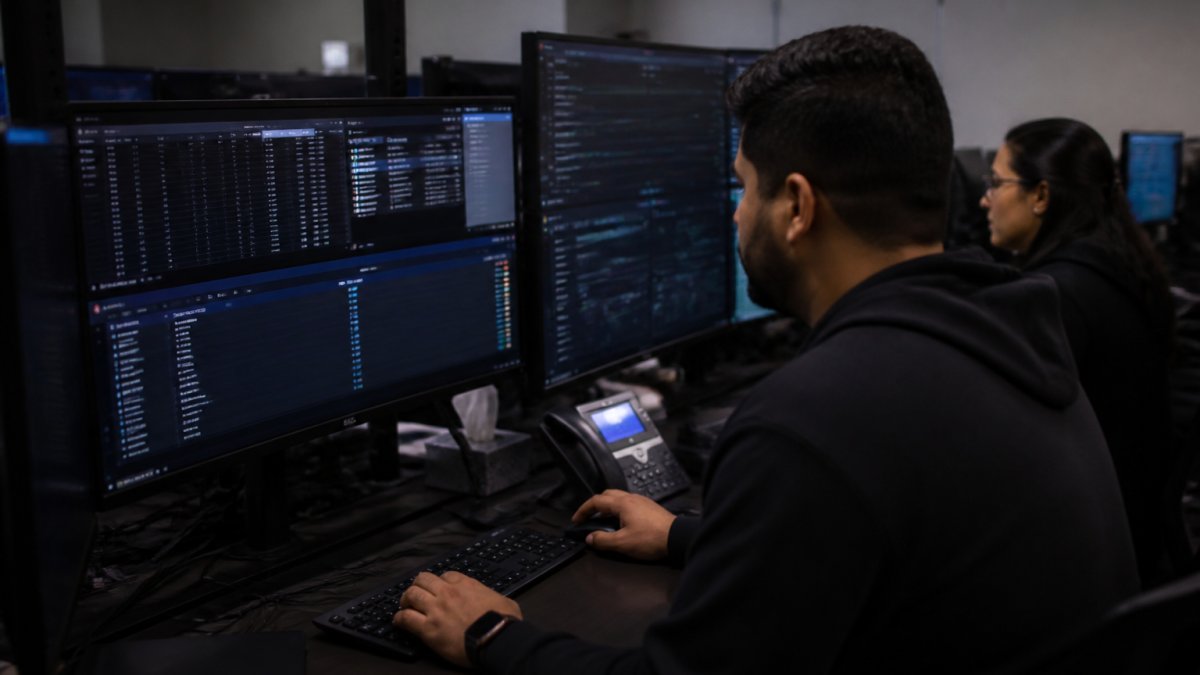
Attackers do not keep business hours. Ransomware, fraud, and unauthorized access attempts cluster at night and on holidays, when internal teams are offline. Business-hours coverage means an intrusion can sit undetected for hours.
24/7 security monitoring can help close that window by enabling alert triage outside business hours. Our article on the benefits of 24/7 security monitoring covers the operational case in detail.
Building an Incident Response Plan Template Your Team Can Execute
An incident response plan template is a written playbook that tells your team exactly what to do when an attack lands. Without one, response becomes improvised, and improvisation costs time.
A workable template covers:
- Detection and triage: who confirms the alert and how fast
- Containment: how to isolate affected systems without halting operations
- Communication: who notifies leadership, legal, and affected parties
- Recovery: restoration steps and validation checks
- Post-incident review: what failed and what changes
Practice it. An untested plan is a document, not a capability. Our 8 steps to effective incident response walks through building one your team can actually run.
Choosing the Right Security Model for Your Organization
The right model matches your risk tolerance, staffing, and regulatory load. A practical decision framework:
- Choose internal-only if you have a mature team, full coverage, and low regulatory exposure.
- Choose managed or hybrid if you need 24/7 coverage, face strict compliance, or your team is stretched thin.
For most Los Angeles enterprises handling sensitive data, hybrid wins. You keep internal context and add enterprise-grade coverage. VegaNext is an AI-native managed service provider offering enterprise-grade cybersecurity, AI automation, and infrastructure management. You can review our cybersecurity services to see how the model fits your environment.
Frequently Asked Questions
What are the risks of relying solely on in-house IT security?
The biggest risks are coverage gaps and burnout. A small internal team cannot watch systems around the clock, so attacks that begin at night or on weekends go unnoticed longer. Staff also need time for patching, compliance work, and incident response, which spreads thin fast. Single-team models also concentrate knowledge, so one departure can leave critical systems exposed.
Is in-house cybersecurity enough for a small or midsize business?
Usually not on its own. A small team can handle routine patching and policy work, but full threat detection, 24/7 security monitoring, and regulatory compliance demand skills and hours most SMBs cannot staff. A hybrid model, where internal staff own strategy and a managed provider handles monitoring and response, may help address that gap.
How does outsourced cybersecurity compare with an in-house security team?
In-house teams know your business deeply and can act fast on internal context. Managed providers bring round-the-clock coverage, specialized tooling, and staff who see threats across many clients. The trade-off is integration: a provider needs time to learn your environment. The right choice depends on your goals, resources, and risk tolerance. Many organizations combine both, keeping a small internal team for strategy and vendor oversight while outsourcing monitoring and incident response.
When should a company consider a managed security provider?
Consider one when your team cannot cover nights and weekends, when compliance deadlines demand documented monitoring, or when alert volume outpaces your staff. Also look at a provider if you lack incident response experience or if third-party and supply-chain risk is growing. A practical first step is a cybersecurity risk assessment checklist to map gaps, then compare the cost of filling them internally against a managed service. For current pricing or a quote, please visit the VegaNext website.
The challenge is not choosing between in-house and outsourced. It is closing the coverage gaps your current model leaves open. VegaNext delivers AI-native managed detection and response, enterprise-grade cybersecurity, and infrastructure management built for enterprises that cannot afford blind spots. Get started with VegaNext and close the gaps before an attacker finds them.