 blog
blog
Top 10 Benefits of 24/7 Security Monitoring
Table of Contents
- Why 24/7 Security Monitoring Matters for Enterprise Operations
- Continuous Security Monitoring Detects Threats Before They Escalate
- Faster Emergency Response Through Real-Time Alerts and Dispatch
- Managed Security Providers Enable Proactive Threat Prevention
- Cybersecurity Incident Response: From Detection to Resolution
- Security Operations Center (SOC) Monitoring Reduces Alert Fatigue
- Measurable ROI: Cost Avoidance and Operational Efficiency
- Conclusion
- Frequently Asked Questions
Last Updated: October 13, 2026
Why 24/7 Security Monitoring Matters for Enterprise Operations
24/7 security monitoring is continuous, round-the-clock surveillance and threat detection across your enterprise infrastructure. At VegaNext, we know threats don't operate on business hours, they strike at 2 AM on a Saturday, during holiday weekends, and whenever your team is least prepared.
Enterprise operations in Los Angeles and nationwide face evolving threats: data breaches, infrastructure attacks, unauthorized access attempts, and compliance violations. Business-hour monitoring leaves dangerous gaps, the moment your team clocks out, your defenses weaken.
24/7 security monitoring changes that equation: professional analysts, automated threat detection, and immediate response protocols operate continuously, so your security posture doesn't diminish after 5 PM. Below are the most significant benefits of continuous monitoring for enterprise-grade security.
Continuous Security Monitoring Detects Threats Before They Escalate
Threat detection speed determines whether you stop an attack early or discover it after the damage is done. Continuous security monitoring identifies suspicious activity the moment it appears, not hours or days later.
An attacker who gains initial access may spend hours or days moving laterally, escalating privileges, and exfiltrating data. Detect after 24 hours and they've already succeeded; detect in 15 minutes and you stop them before they move beyond initial access.
Automated systems track network traffic, user behavior, system logs, and access patterns in real time. When something deviates, an unusual login, unexpected data transfers, suspicious process execution, the system flags it immediately, and human analysts verify the threat and initiate response.
This is especially critical for Los Angeles organizations managing sensitive data in healthcare, finance, and supply chain, where regulations mandate rapid breach notification. Early detection means notifying affected parties within hours rather than weeks.
Faster Emergency Response Through Real-Time Alerts and Dispatch
When a threat is detected, response speed determines impact. Real-time alerts trigger immediate action instead of waiting for someone to notice during their next shift.
The response chain, detection → alert → analyst review → verification → incident response → law enforcement dispatch, executes immediately, any time of day or night. An alert at 3 AM gets the same rapid response as one at 3 PM, with your SOC staff or managed provider responding within minutes, not hours.
For physical incidents, faster response means law enforcement arrives while the threat is still present; for cyber incidents, it means isolating compromised systems before data is exfiltrated. Los Angeles enterprises managing critical infrastructure, financial systems, or healthcare cannot afford delays, faster response is a business requirement.
Managed Security Providers Enable Proactive Threat Prevention
Managed security providers operate your security infrastructure on your behalf, staffing analysts, maintaining monitoring tools, responding to incidents, and handling threat investigation. Building an in-house SOC requires experienced analysts, monitoring tools, 24/7 staffing rotations, and constant threat research, which is cost-prohibitive for most organizations. Managed providers spread those costs across clients while specializing in detection and response.
VegaNext delivers enterprise-grade cybersecurity through AI-native managed services. Our platform combines automated threat detection with human expertise. Analysts review alerts, investigate suspicious activity, and respond to incidents around the clock. You get professional-grade security without building and staffing a full SOC internally.
Proactive threat prevention means identifying vulnerabilities, misconfigurations, and security gaps before attackers exploit them. Providers conduct regular assessments, apply patches, monitor emerging threats, and recommend improvements, preventing many attacks outright.
Cybersecurity Incident Response: From Detection to Resolution
Cybersecurity incident response follows a standard process: detect the threat, contain it, investigate what happened, eradicate the attacker's presence, recover affected systems, and conduct post-incident review. Skipping any phase leaves vulnerabilities open. Rigorous adherence to these protocols mirrors the proactive defense mechanisms inherent in smart home security systems, which extend this cycle of vigilance to the residential environment.
Continuous monitoring feeds this process: detection happens immediately, containment begins within minutes, investigation identifies how the attacker gained access, and eradication and recovery restore normal operations.
For Los Angeles organizations in regulated industries (healthcare, finance, insurance), incident response is mandated: HIPAA, PCI-DSS, and other frameworks require documented procedures and rapid notification. VegaNext's incident response integrates with your infrastructure, our team investigates, coordinates containment, and documents findings for compliance reporting so you meet regulatory timelines.
Security Operations Center (SOC) Monitoring Reduces Alert Fatigue
A security operations center (SOC) is only as good as the alerts it escalates. Poorly tuned monitoring floods analysts with false positives, desensitizing them until real threats get buried and response slows. That is alert fatigue, the most common failure mode in 24/7 monitoring.

The fix is not fewer alerts, it is better alerts. Here is how a well-run monitoring operation actually works from the moment a sensor trips to the moment help is on the way, so you can judge whether a provider's "24/7" claim is real.
Step 1, Signal receipt. A sensor, camera analytic, door contact, motion detector, or network agent sends an event to the monitoring center. Good centers use redundant paths (primary internet plus cellular or radio backup) so one outage doesn't blind the account.
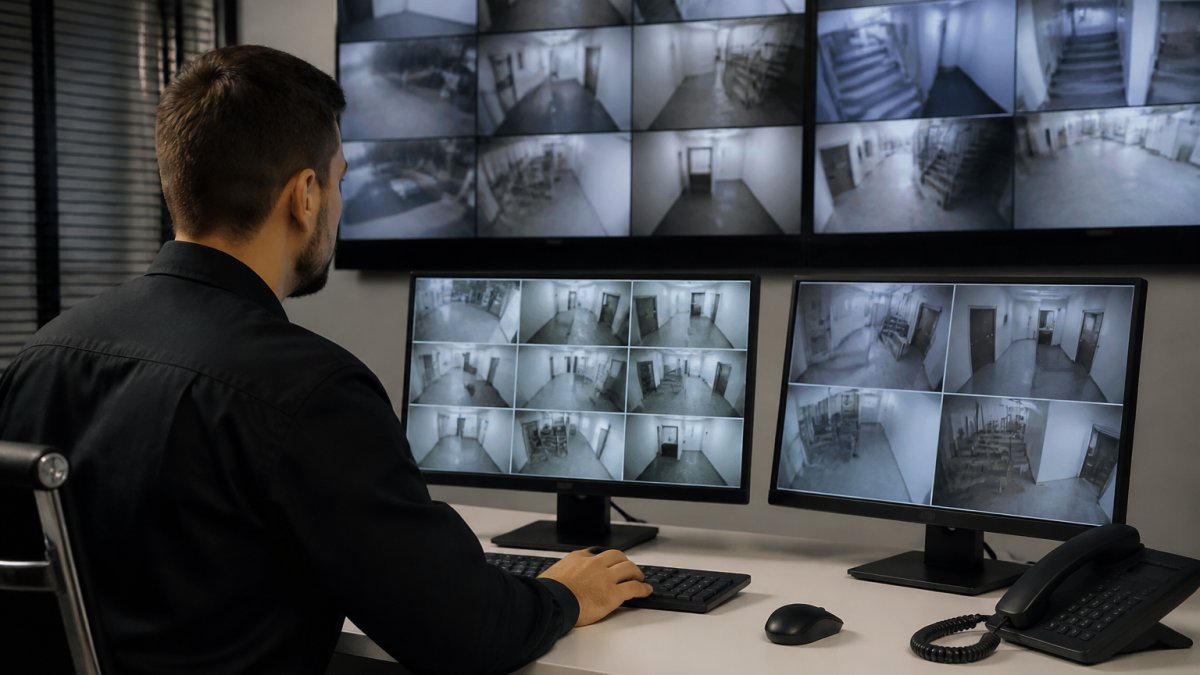
Step 2, Verification. This is where quality separates providers. A trained operator reviews the event, checks camera feeds or sensor context, and determines whether it is a genuine threat or a false trigger.
Step 3, Contacting the occupant or keyholder. If the event is credible, the center reaches the account holder, on-site contact, or keyholder to confirm before escalating. Documented call lists and escalation trees matter, an outdated phone number can stall a real response.
Step 4, Escalation to emergency responders. If verification confirms a threat, or the account holder requests it, the center dispatches to the appropriate agency. For cyber incidents, the equivalent step is isolating the affected system, revoking credentials, and notifying your incident response lead.
Step 5, Documentation. Every event, call, and dispatch is logged, supporting insurance claims, compliance audits, and after-action reviews. Two distinctions matter when evaluating a provider:
- Monitoring-center response time vs. police arrival time. A center can acknowledge and verify an alarm in seconds to a couple of minutes. Police arrival depends on your jurisdiction, call priority, and current demand. No provider can guarantee a police arrival time, and any that does is overselling.
- Verification requirements vary by jurisdiction. Many U.S. cities and counties have ordinances that require verified alarms before police will respond to certain call types, and some impose fines for repeated false alarms. A provider that understands local dispatch rules will help you stay compliant and avoid fines.
Effective SOC monitoring uses intelligent filtering and correlation: instead of alerting on every motion event, the system correlates signals, applies threat intelligence, and surfaces only high-confidence threats, so analysts investigate fewer alerts but respond to more real incidents.
Measurable ROI: Cost Avoidance and Operational Efficiency
Security spending needs a business case, and "peace of mind" is not one. 24/7 security monitoring earns its budget through cost avoidance, operational efficiency, and documentable risk reduction. Here's how to measure it, and what to demand from a provider.
Cost avoidance from prevented incidents. A single significant breach or burglary carries direct costs (loss, repair, downtime), indirect costs (deductibles, higher premiums), and reputational costs.
Operational efficiency from automation. Automated detection handles routine monitoring so analysts focus on complex investigations. Measure it via alert volume per analyst and mean time to acknowledge, if a provider can't tell you how many alerts your account generates and how fast they're triaged, you can't measure efficiency gains.
Compliance and audit posture. HIPAA, PCI-DSS, and similar frameworks expect documented monitoring and incident response. A 24/7 program with retained logs and defined escalation procedures gives auditors concrete evidence, reducing findings and shortening audit cycles.
False-alarm fines and wasted dispatches. Many U.S. municipalities fine properties for repeated false alarms, and some require verification before police respond. Strong verification reduces unnecessary dispatches, cutting fines and friction.
What to demand before you sign. Use this checklist to separate real 24/7 coverage from marketing:
- Staffing model. Is the center staffed around the clock by trained operators, or is it an automated system with on-call humans? Ask how many operators are on shift at 3 AM.
- Redundant communications. Primary internet plus cellular or radio backup, so a single outage does not disable monitoring.
- Power resilience. Backup power and generator capacity at the monitoring center.
- Escalation procedures. Written call lists, keyholder trees, and defined thresholds for contacting police, fire, or your internal team.
- Verification policy. How alarms are verified before dispatch, and how that interacts with your local ordinances.
- Service transparency. Published or contractual response-time expectations for acknowledgment and verification, with the clear caveat that police arrival time is outside any provider's control.
- Data and privacy terms. Who can view camera feeds, how long footage and logs are retained, and how access permissions are managed.
Privacy and data boundaries. Camera monitoring raises real questions: who accesses live and recorded video, how long it's kept, and how it's protected. A credible provider documents retention periods, restricts access by role, and explains how footage is stored and deleted, which ties into your broader data-security obligations.
For Los Angeles organizations, the stakes are concrete: notification costs, forensics, regulatory exposure, and reputation damage from a serious incident can run into the millions. Investing in prevention through continuous monitoring, with a provider whose service levels you can verify, is the economically rational choice.
Conclusion
24/7 security monitoring transforms how enterprises defend against threats. Continuous detection catches attacks early. Real-time response limits damage. Professional monitoring eliminates gaps that occur when teams work business hours only. For organizations in Los Angeles managing critical infrastructure and sensitive data, continuous monitoring is essential.
VegaNext delivers enterprise-grade security through AI-native managed services. Our platform combines automated threat detection, human expertise, and proactive incident response. We monitor your infrastructure continuously, detect threats immediately, and respond within minutes, any time of day or night.
Your security doesn't rest. Neither should your monitoring. Contact VegaNext today to learn how continuous security monitoring can strengthen your enterprise defenses and reduce breach risk.
| Benefit | Impact | Best For |
|---|---|---|
| Early threat detection | Stops attacks before escalation | All organizations |
| Faster response times | Limits damage from incidents | Critical infrastructure |
| Reduced alert fatigue | Improves analyst efficiency | Large enterprises |
| Compliance support | Demonstrates security controls | Regulated industries |
| Cost avoidance | Prevents breach expenses | All organizations |
Frequently Asked Questions
How does 24/7 security monitoring work from alarm to dispatch?
When a threat is detected, your monitoring system sends an alert to the security operations center. Trained analysts verify the threat through multiple data points, sensor logs, network activity, and contextual information, before alerting emergency services or your internal team. This verification process reduces false alarms and ensures dispatch resources respond only to genuine incidents, cutting response time from hours to minutes.
What is the difference between continuous security monitoring and incident response?
Continuous security monitoring is the ongoing observation of your network and systems for suspicious activity 24/7. Incident response is the action taken when a threat is confirmed, containment, investigation, and remediation. Effective 24/7 security monitoring triggers faster incident response because threats are caught early, before attackers move laterally or exfiltrate data. Together, they reduce dwell time and minimize damage.
Can a managed security provider handle legacy systems, cloud, and on-premises infrastructure?
Yes. Enterprise managed security providers are built to integrate across hybrid environments. They deploy agents and sensors across legacy systems, cloud platforms, and on-premises infrastructure, consolidating all data into a single security operations center. This unified visibility eliminates blind spots and ensures consistent threat detection regardless of where your assets live, though integration complexity depends on your specific environment.
What threats can continuous security monitoring detect that internal teams might miss?
Continuous monitoring detects intrusion attempts, unauthorized access, data exfiltration, malware execution, supply chain attacks, insider threats, and environmental anomalies, all patterns that human analysts working standard hours might overlook. AI-powered monitoring also identifies subtle, multi-stage attacks that require correlation across thousands of events. Round-the-clock vigilance catches threats during nights, weekends, and holidays when your internal team is unavailable.