 listicle
Why AI Integration Projects Fail: 7 Root Causes
Table of Contents
- The Challenges of AI Adoption in Business That Leaders Underestimate
- Why AI Integration Projects Fail: 7 Root Causes
- 1. Lack of Clear Business Objectives
- 2. Poor Data Quality and Broken Data Governance
- 3. Misaligned ROI Expectations and No Defined KPIs
- 4. Skill Gaps and Insufficient Employee Training
- 5. Siloed Initiatives and Absent Executive Sponsorship
- 6. Technology Misapplication and Legacy Infrastructure Friction
- 7. Post-Implementation Drift and Ethical Compliance Failures
- The Change Management Psychology Behind AI Resistance
- AI Implementation Best Practices That Actually Reduce Failure Risk
- Measuring AI Project ROI: What to Track and When
- Why AI Integration Projects Fail Even After a Successful Launch
- Frequently Asked Questions
Last Updated: August 5, 2026
The Challenges of AI Adoption in Business That Leaders Underestimate
Most organizations treat AI integration like conventional software rollouts and fail before training begins. The pattern is consistent: promising proof of concept, executive enthusiasm, budget approval, then months later, a shelved deployment nobody mentions in quarterly reviews.
At VegaNext, we work with CTOs, IT Directors, and Digital Transformation Leads across Los Angeles and nationally who have lived this scenario. The challenges of AI adoption are not primarily technical, they are strategic, organizational, and deeply human. According to Gartner's AI adoption research, a significant proportion of AI pilot projects never reach full production deployment. The reasons cluster around a small set of preventable root causes.
Below, we break down why AI integration projects fail, what warning signs appear at each stage, and what actually works to change the outcome.
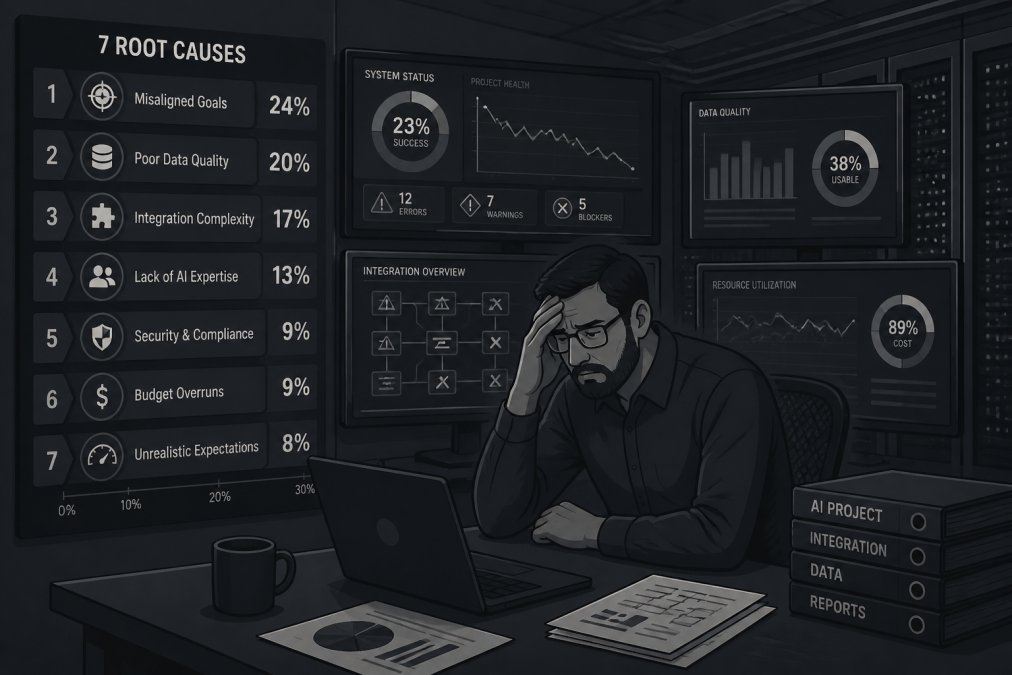
Why AI Integration Projects Fail: 7 Root Causes
AI integration projects fail when business strategy, data infrastructure, and organizational readiness misalign with the technical deployment plan. The failure accumulates across decisions made weeks or months before go-live.
1. Lack of Clear Business Objectives
The most common reason AI projects fail is the absence of a concrete, measurable business problem the AI solves. Teams get excited about technology and build toward capability rather than outcome. "We want to use machine learning to improve operations" is not a business objective, it is a wish.
Without defined KPIs tied directly to business objectives, there is no way to evaluate whether the AI works or when to intervene. Before any model training begins, write down the specific metric the AI is expected to move, the baseline value today, and the target value within a defined timeframe. If you cannot do this, the project is not ready to start.
2. Poor Data Quality and Broken Data Governance
Machine learning models are only as reliable as the data they train on. Organizations consistently underestimate how much work is required to get data into usable state.
Data silos are the structural version of this problem. When customer data lives in one system, operational data in another, and financial data in a third with no consistent governance framework, the model trains on an incomplete and contradictory picture of reality. Effective data governance means establishing ownership, quality standards, and access controls before the AI project launches. Tools like Cleanlab Studio can automate detection of mislabeled and corrupted training data.
3. Misaligned ROI Expectations and No Defined KPIs
Misaligned return on investment expectations kill more AI projects than technical failures. Leadership approves a budget based on projected gains, implementation takes longer than planned, early results are ambiguous, and the project gets defunded before reaching the performance threshold where value becomes visible.
AI systems improve over time as they process more data. The ROI curve is not linear, and expecting payback within the first quarter is a structural misunderstanding. Defining realistic KPIs upfront with a clear timeline for metric movement is the only way to protect the project from premature cancellation.
4. Skill Gaps and Insufficient Employee Training
Deploying an AI system into a workforce that does not understand it, does not trust it, or does not know how to interpret its outputs is not a deployment, it is an expensive experiment in change resistance.
Skill gaps operate at two levels. Technically, teams may lack expertise to maintain the model, retrain it when performance degrades, or troubleshoot unexpected outputs. Operationally, employees using the AI's recommendations may not understand what the model does well enough to know when to follow it and when to override it. Both gaps require deliberate investment in technical training and workflow integration training. Organizations that treat employee training as an afterthought report lower adoption rates and higher abandonment.
5. Siloed Initiatives and Absent Executive Sponsorship
AI integration projects that live entirely within one department rarely scale. Without cross-functional teams involved from the start, the AI optimizes for one function's objectives while creating friction elsewhere. A supply chain AI that reduces inventory costs but creates fulfillment problems is not a success.
The absence of executive sponsorship compounds this. Without a senior leader with cross-functional visibility and authority to resolve resource conflicts, AI projects get stuck in organizational politics. Budget decisions stall. Data access requests get deprioritized. The project loses momentum and its champion.
6. Technology Misapplication and Legacy Infrastructure Friction
Not every business problem requires a deep learning model. Some are better served by simpler rule-based automation or predictive analytics. Deploying a complex generative AI solution where a structured workflow would suffice adds cost, latency, and maintenance overhead without proportional benefit.
Legacy infrastructure creates friction. Many enterprises run hybrid environments mixing on-premises systems, multiple cloud providers, and software predating modern API standards. Integrating AI requires careful planning around data pipelines, authentication, and latency. Technical debt in existing infrastructure does not disappear when a new AI layer is added, it gets more expensive to manage. According to McKinsey's research on digital transformation, infrastructure modernization is consistently cited as a top barrier to scaling AI across the enterprise.
7. Post-Implementation Drift and Ethical Compliance Failures
Post-implementation drift occurs when a model that performed well at launch degrades because real-world data no longer matches the training distribution. Markets change. Customer behavior shifts. Regulatory requirements evolve. The model does not automatically adapt. Without systematic monitoring, drift goes undetected until outputs become visibly wrong.
Ethical and regulatory compliance failures represent distinct risk. Algorithmic bias, privacy violations, and non-compliant automated decision-making create material legal and reputational exposure in regulated industries. Platforms like Arize AI and Fiddler AI provide real-time model monitoring and drift detection. Credo AI's governance platform automates audit readiness and risk assessment across bias, security, and privacy dimensions.
Post-implementation maintenance is not optional, it is the difference between an AI system that delivers sustained value and one that becomes a liability.
The Change Management Psychology Behind AI Resistance
Most AI implementation best practices focus on technical and strategic dimensions. The human dimension gets addressed last, if at all.
AI resistance follows a predictable psychological pattern. Employees who perceive AI as a threat to their role will work around it, undermine adoption, or simply not use it. This is rational response to ambiguity about what the AI means for their position and expertise.
Effective change management addresses this directly. Communicate clearly about what the AI will and will not do. Involve frontline users in design and testing. Frame the AI as a tool that augments human judgment rather than replaces it. Organizations that invest in change management psychology before deployment report meaningfully higher adoption rates and faster time-to-value. The resistance is not about technology, it is about trust.
AI Implementation Best Practices That Actually Reduce Failure Risk
Organizations that successfully deploy AI share structural habits distinct from those that fail. These are operational patterns that show up consistently in deployments reaching production and delivering measurable value.

Start with a Bounded Pilot Project, Not a Full Deployment
The single most effective risk mitigation strategy is starting small and deliberately. A bounded pilot with defined scope, specific business objective, fixed timeline, and clear success criteria gives the organization a low-stakes environment to learn how the AI performs against real data, how employees respond, and where infrastructure gaps are.
Pilot projects should fail fast and cheaply if the approach is wrong. The goal is not to prove the AI works, it is to learn what it takes to make it work in this organizational context.
Build Cross-Functional Teams Before Writing Code
AI integration projects that start in one department and expand later face structural disadvantage. Architecture decisions reflect the priorities of the team that built it, not the organization it serves.
Building cross-functional teams from the start means including representatives from functions affected by the AI's outputs: operations, compliance, HR, finance, and end users. This surfaces integration requirements, data access needs, and workflow constraints before they become expensive problems. According to Harvard Business Review's analysis of AI project failures, organizations that successfully scale AI consistently report that cross-functional alignment was critical to moving from pilot to production.
Measuring AI Project ROI: What to Track and When
Measuring AI project ROI depends on the business objective the AI addresses, but timing of measurement is equally important.
| Measurement Phase | What to Track | When to Measure |
|---|---|---|
| Pre-deployment baseline | Current process time, error rate, cost per transaction | 4-6 weeks before go-live |
| Early adoption | User adoption rate, model output accuracy, system uptime | First 30-60 days post-launch |
| Operational performance | KPI movement vs. baseline, false positive/negative rates | 60-120 days post-launch |
| Long-term value | Total cost of ownership, model drift indicators, compliance audit results | 6-12 months post-launch |
| Strategic impact | Revenue attribution, operational efficiency gains, risk reduction | 12+ months post-launch |
The most common ROI measurement mistake is evaluating AI performance against a theoretical perfect system. The correct comparison is against the process the AI replaced, measured on the same metrics over the same time period.
For regulated industries, ROI must account for risk reduction. An AI system that reduces the probability of compliance failure or security breach has quantifiable value even if it never directly generates revenue.
Why AI Integration Projects Fail Even After a Successful Launch
A successful launch is not the same as a successful deployment. Many AI projects that clear every technical hurdle and achieve strong early adoption still fail to deliver sustained value because the organization treats go-live as the finish line.
Post-launch failure takes several forms. Model drift degrades prediction quality over time. Organizational changes disconnect the AI from the workflow it supports. Budget cycles treating AI as one-time capital expense rather than ongoing operational investment lead to under-resourcing maintenance and monitoring.
Organizations that avoid this pattern treat AI deployment as continuous operational capability rather than a project with a defined end date. They staff accordingly, budget accordingly, and build monitoring infrastructure to detect performance degradation before it becomes visible to end users.
For enterprises managing complex hybrid infrastructure across on-premises and cloud environments, continuous AI operations management is where a partner like VegaNext adds structural value. VegaNext's AI-native managed service model handles ongoing infrastructure management, security monitoring, and AI automation oversight that in-house teams frequently lack capacity to sustain. The 24/7 managed service model means monitoring and maintenance happens continuously, not just when internal teams have bandwidth.
AI integration projects fail for predictable, addressable reasons. The challenge is organizational discipline, executive commitment, and treating AI deployment as a long-term operational investment rather than a one-time technology project. For enterprises navigating legacy infrastructure complexity, skill gaps, and ongoing post-deployment maintenance demands, VegaNext provides the AI-native infrastructure management and enterprise-grade cybersecurity support that makes sustained AI operations achievable. Get started with VegaNext and build the foundation your AI integration actually needs to succeed.
Frequently Asked Questions
What is the failure rate of AI projects?
Estimates from multiple research organizations consistently place the failure rate of AI projects between 80% and 85%. Most failures are not caused by the technology itself but by organizational issues: unclear business objectives, poor data quality, absent executive sponsorship, and insufficient change management. Enterprises that define measurable KPIs before deployment and run bounded pilot projects before full-scale rollout see significantly better outcomes than those that skip the planning phase.
How does poor data quality lead to AI project failure?
Machine learning models are only as reliable as the data used to train them. When training data contains gaps, duplicate records, mislabeled entries, or reflects historical bias, the resulting model produces inaccurate predictions in production. In healthcare and financial services, this is especially costly: a model trained on incomplete patient records or flawed transaction data can generate harmful recommendations. Establishing data governance standards and running data quality audits before model training begins is the most direct way to reduce this risk.
Why do most AI initiatives fail to deliver ROI?
The most common reason AI integration projects fail to deliver return on investment is that success metrics are never defined before deployment. Teams measure activity, such as models deployed or hours automated, rather than business outcomes like reduced incident response time or lower operational cost per transaction. Measuring AI project ROI requires baseline data captured before go-live, a defined measurement window, and agreement across stakeholders on which KPIs actually reflect business value rather than technical throughput.
What role does company culture play in AI integration failure?
Culture is frequently the deciding factor when AI integration projects fail despite solid technology and clean data. Employees who perceive AI as a threat to their roles resist adoption passively: they revert to manual workflows, avoid the new tools, or fail to flag model errors. Addressing this requires transparent communication from leadership about how AI changes job functions rather than eliminating them, structured training programs, and visible executive sponsorship that signals organizational commitment rather than a short-term pilot experiment.
This article was written using GrandRanker