 ultimate-guide
Managed Security for Financial Institutions: A 2026 Guide
Table of Contents
- Why Managed Security Matters for Financial Institutions
- GLBA Compliance Checklist for Banks: Core Requirements
- 24/7 Threat Detection and Incident Response
- FFIEC Cybersecurity Assessment Tool: Evaluating Your Security Posture
- Incident Response Planning for Financial Institutions
- Choosing the Right Managed Security Provider
- Conclusion
Last Updated: August 16, 2026
Why Managed Security Matters for Financial Institutions
Financial institutions face a threat landscape unlike any other industry. Attackers target banks, credit unions, and fintech companies for customer data and the systems that move money itself. A single breach can expose millions of account holders, trigger regulatory fines, and destroy institutional trust in days.
Data breaches in the financial sector average over $4 million in total impact when accounting for incident response, regulatory penalties, and reputational damage. Yet many institutions still rely on fragmented security tools, overworked internal teams, and reactive incident response plans.
Modern managed security combines AI-driven threat hunting, automated vulnerability patching, and real-time compliance auditing into a cohesive security posture that adapts faster than internal teams alone can manage. Rather than maintaining security operations entirely in-house, institutions partner with specialized providers to deliver 24/7 threat detection, compliance automation, and incident response capabilities.
At VegaNext, we work with financial institutions across the country to implement enterprise-grade managed security solutions that reduce alert fatigue, accelerate incident response, and maintain continuous compliance with regulatory frameworks.
GLBA Compliance Checklist for Banks: Core Requirements
The Gramm-Leach-Bliley Act requires financial institutions to protect customer information through administrative, technical, and physical safeguards. Effective GLBA compliance requires three foundational elements: implementing safeguards that protect the confidentiality, integrity, and availability of customer data; maintaining a documented incident response plan with notification procedures and evidence preservation protocols; and maintaining audit trails of all access to sensitive data.
A practical GLBA compliance checklist includes:
- Encrypt all customer data in transit (TLS 1.2 or higher) and at rest (AES-256 minimum)
- Implement multi-factor authentication for all administrative access to systems containing customer data
- Conduct quarterly vulnerability assessments and remediate findings within documented timeframes
- Maintain centralized logging and monitoring of all access to customer information systems
- Document and test incident response procedures at least annually
- Conduct annual security awareness training for all employees with access to customer data
- Perform background checks on all personnel with access to sensitive systems
- Establish a third-party risk management program that includes vendor security assessments
Managed security providers handle much of this compliance burden by automating vulnerability scanning, centralizing audit logs, and alerting your team when suspicious access patterns emerge. This shifts your team from reactive compliance reporting to proactive threat response.
24/7 Threat Detection and Incident Response
The difference between a contained breach and a catastrophic one often comes down to detection speed. The average time to detect a breach in financial institutions is measured in weeks or months, far too long when attackers can move money or exfiltrate data in hours.
A 24/7 security operations center (SOC) monitors network traffic, endpoint behavior, and user activity across your entire infrastructure in real time. The SOC correlates events across multiple systems to identify attack patterns that isolated tools would miss. When a user account is created outside normal business hours, logs into a system it's never accessed before, and downloads large volumes of data, the SOC flags this immediately.
Traditional security tools generate thousands of alerts daily, many false positives. Managed security providers address this by using threat intelligence and behavioral analytics to filter alerts down to the ones that matter. Instead of 10,000 alerts per day, your team sees 50, and those 50 are genuinely suspicious.

When a threat is detected, the provider's incident response team immediately begins containment: isolating affected systems, preserving evidence, and preventing lateral movement. Your internal team provides context and authorization, but the technical response begins within minutes, not hours. This speed is critical, an incident that spreads to additional systems in the first hour costs exponentially more to remediate than one that's contained immediately.
The incident response plan must specify communication protocols, evidence preservation requirements, and regulatory notification timelines. Financial institutions must notify regulators within 30 days and affected customers within 60 days. A managed security provider helps you meet these deadlines by documenting the incident investigation thoroughly and generating the regulatory notification documents your legal team requires.
FFIEC Cybersecurity Assessment Tool: Evaluating Your Security Posture
The Federal Financial Institutions Examination Council publishes guidance on cybersecurity that effectively sets the standard for how regulators evaluate your security program. The FFIEC assessment framework evaluates five core areas: governance and risk management, threat intelligence and collaboration, security controls and techniques, third-party risk management, and incident response capabilities.
Governance and risk management requires that your board of directors understands cybersecurity risks and that your institution has dedicated resources and budget for security. Regulators expect your board to receive quarterly security briefings and to approve your cybersecurity budget explicitly.
Threat intelligence and collaboration requires that your institution participates in information sharing about emerging threats, such as joining the Financial Services Information Sharing and Analysis Center (FS-ISAC), which distributes threat intelligence specific to financial institutions.
Security controls and techniques evaluates whether your institution uses industry-standard controls: multi-factor authentication, encryption, network segmentation, and vulnerability management. Managed security providers implement and maintain these controls at scale, ensuring consistent application across all systems.
Third-party risk management is increasingly critical. Your institution likely relies on dozens of vendors whose breaches could expose your data. The FFIEC assessment requires a formal vendor risk management program: assess vendors before engaging them, monitor their security posture continuously, and maintain contractual requirements for how they handle your data.
Incident response capabilities require that your institution has tested its incident response plan and can demonstrate quick detection, investigation, and remediation. Regulators will ask to see evidence of tabletop exercises or actual incidents your institution has handled.
A managed security provider helps you meet FFIEC expectations by providing continuous monitoring that demonstrates strong security controls, participating in threat intelligence sharing, and conducting regular incident response drills.
Incident Response Planning for Financial Institutions
An incident response plan is a living operational procedure that your team must practice regularly and update as your infrastructure changes. An effective plan includes detection and analysis procedures, containment strategies, evidence preservation protocols, communication procedures, regulatory notification procedures, recovery procedures, and post-incident review processes.
Detection and analysis is where managed security makes the biggest difference. Your internal team cannot monitor all systems 24/7, but a managed security provider can. When the provider's SOC detects suspicious activity, they immediately alert your incident response team with context about what was detected and which systems are affected.
Containment requires speed and knowledge. An incident response team experienced with financial institution breaches knows attack patterns and can make containment decisions quickly, preventing lateral movement while preserving forensic evidence.
Evidence preservation is critical for both forensic investigation and regulatory compliance. A managed security provider's incident response team knows what evidence to collect and how to preserve it in a legally defensible manner.
Communication during an incident must be clear and defined in advance. Your plan must specify that the CISO is the decision maker, that legal is involved from the start, and that executives are briefed regularly.
Regulatory notification is non-negotiable. Financial institutions must notify regulators of material incidents within 30 days, including what happened, when it was detected, what customer data was affected, and remediation steps underway.
Post-incident review captures what went well and what didn't, feeding lessons back into improving your incident response plan.
Choosing the Right Managed Security Provider
Not all managed security providers are equal. The right provider for your financial institution combines threat detection expertise, regulatory knowledge, and operational reliability.
Start by evaluating the provider's experience with financial institutions specifically. A provider that has worked with banks and credit unions understands the regulatory landscape, threat landscape, and operational constraints of financial services.
Ask the provider for references from similar institutions. Ask specific questions: How quickly did the provider detect incidents? How well did they understand your compliance requirements? Did they reduce your alert volume? References from institutions similar to yours in size and complexity are far more valuable than references from much larger or smaller organizations.
Evaluate the provider's threat intelligence capabilities. Do they participate in financial sector threat sharing? Do they have dedicated threat researchers who understand attacks targeting financial institutions? A provider that just resells generic threat intelligence won't catch threats specifically targeting your sector.
Assess the provider's incident response capabilities. Do they have a dedicated incident response team? How quickly can they respond to an incident at your institution? A provider with established relationships with law enforcement can often coordinate investigations more effectively than your internal team.
Verify the provider's security posture. Ask for their SOC 2 Type II report, which demonstrates that their own systems are secure. Ask about their incident history: have they themselves suffered breaches, and if so, how did they respond?
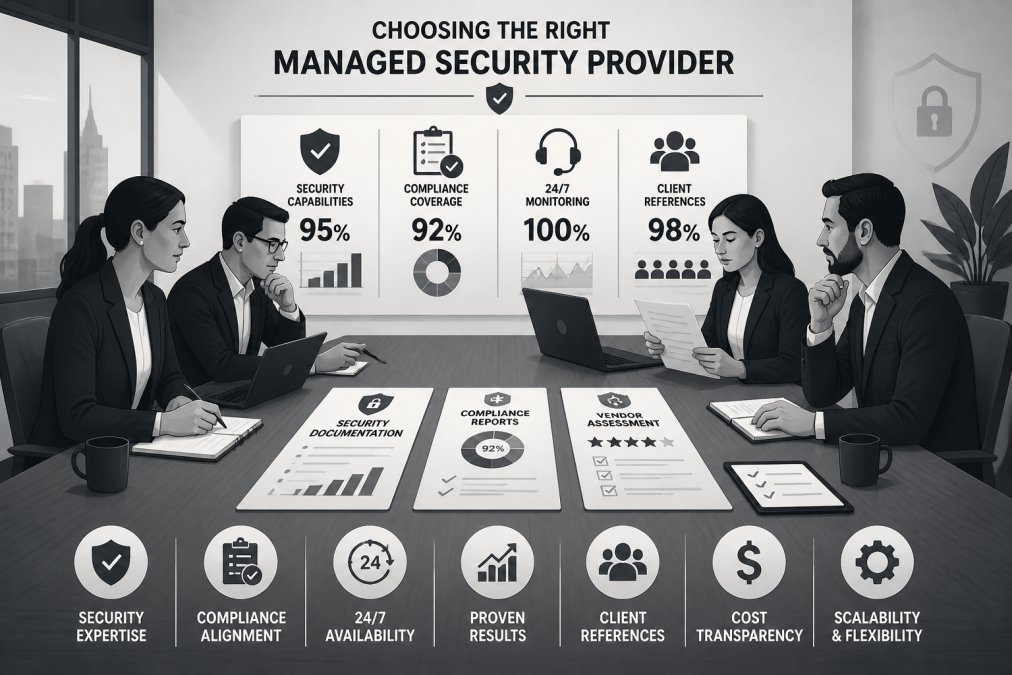
Understand the provider's integration approach. Will they integrate with your existing SIEM, or do they require you to move to their platform? A provider that integrates smoothly with your existing tools requires less disruption.
Evaluate pricing and service levels. Managed security pricing typically scales with the number of systems monitored and the level of response required. Verify that the provider's service level agreement matches your requirements.
Finally, assess the provider's communication and reporting. Do they provide regular threat briefings? Do they generate compliance reports automatically? A provider that communicates proactively is far easier to work with than one that requires you to pull information from them.
Managed security for financial institutions has moved beyond a nice-to-have to a business necessity. Regulators expect it, customers demand it, and the threat landscape makes it unavoidable. The institutions that succeed are those that partner with providers who combine threat detection expertise with regulatory knowledge and operational reliability.
VegaNext delivers enterprise-grade managed security specifically designed for financial institutions. Our AI-native platform combines 24/7 threat detection with automated compliance monitoring, reducing alert fatigue while maintaining the visibility regulators require. We handle the operational burden of security monitoring and incident response, freeing your team to focus on strategic security initiatives. Get started with VegaNext and transform your security posture from reactive to proactive.
Frequently Asked Questions
What are the primary cybersecurity requirements for financial institutions under GLBA?
The Gramm-Leach-Bliley Act requires financial institutions to implement administrative, technical, and physical safeguards to protect customer information. Key requirements include designating a qualified individual to oversee your security program, conducting regular risk assessments, implementing multi-factor authentication, encrypting sensitive data, and maintaining an incident response plan. Managed security providers help you meet these requirements through continuous monitoring, vulnerability management, and compliance auditing.
How does an MSSP help banks meet FFIEC compliance standards?
Managed Security Service Providers (MSSPs) support FFIEC compliance by providing 24/7 security monitoring, threat intelligence, and incident response capabilities. They conduct regular security assessments, maintain detailed logs for audit trails, implement zero trust architecture principles, and help you document your security controls. This continuous oversight and documentation simplifies compliance audits and demonstrates to regulators that you're maintaining an effective security program.
What is the difference between managed IT services and managed security services for banks?
Managed IT services focus on maintaining your infrastructure, servers, networks, and endpoints, to keep systems running smoothly. Managed security services specifically target threat detection, prevention, and response. For financial institutions, managed security goes deeper: it includes security operations center monitoring, vulnerability scanning, penetration testing, threat hunting, and incident response planning. Many organizations benefit from both, but managed security is essential for meeting regulatory requirements.
How do financial institutions protect against ransomware and data breaches?
Protection requires multiple layers: endpoint security to block malicious files, network monitoring to detect suspicious activity, multi-factor authentication to prevent unauthorized access, and regular patching to close vulnerabilities. Managed security providers add AI-driven threat hunting to identify threats early, automated response to isolate compromised systems, and incident response planning so your team knows exactly what to do if an attack occurs. Regular security awareness training for employees also reduces the risk of successful phishing attacks that often precede breaches.
This article was written using GrandRanker