 ultimate-guide
Managed Detection for Healthcare: A 2026 Guide
Table of Contents
- What Is Managed Detection and Response for Healthcare?
- Why Healthcare Organizations Need Managed Detection
- HIPAA Compliant Managed Security Services
- Healthcare Ransomware Protection Strategies
- Key Capabilities: Threat Hunting, Incident Response, and 24/7 Monitoring
- Protecting Electronic Health Records and Clinical Uptime
- How to Choose the Right Managed Detection Provider
- Conclusion
What Is Managed Detection and Response for Healthcare?
Managed Detection and Response (MDR) is a cybersecurity service that combines continuous monitoring, threat hunting, and incident response capabilities to identify and neutralize attacks before they damage critical systems. For healthcare organizations, MDR means 24/7 surveillance of your network, endpoints, and cloud infrastructure with expert analysts ready to investigate suspicious activity in real time.
Unlike traditional security tools that generate alerts and leave you to investigate them, MDR services actively hunt for threats, correlate data across your entire infrastructure, and respond immediately when an attack is detected. Healthcare systems are particularly vulnerable because attackers know patient data commands premium prices on the dark web, and operational downtime can directly impact patient care. An MDR provider becomes an extension of your security team, handling the labor-intensive work of threat analysis so your in-house staff can focus on strategic security improvements.
The core difference between MDR and a traditional Security Operations Center (SOC) is accountability. An MDR vendor assumes responsibility for detecting and responding to threats, not just providing tools and hoping you use them correctly. This shift matters enormously for healthcare organizations stretched thin managing legacy systems, electronic health records, and compliance obligations simultaneously.
Why Healthcare Organizations Need Managed Detection
Healthcare networks are under relentless attack. Ransomware operators specifically target hospitals because they know payment is likely, patient safety creates pressure to pay quickly. Insider threats are common because healthcare employees have legitimate access to sensitive data but may be compromised or disgruntled. Supply chain attacks arrive through medical device vendors and software providers that connect directly to clinical systems.
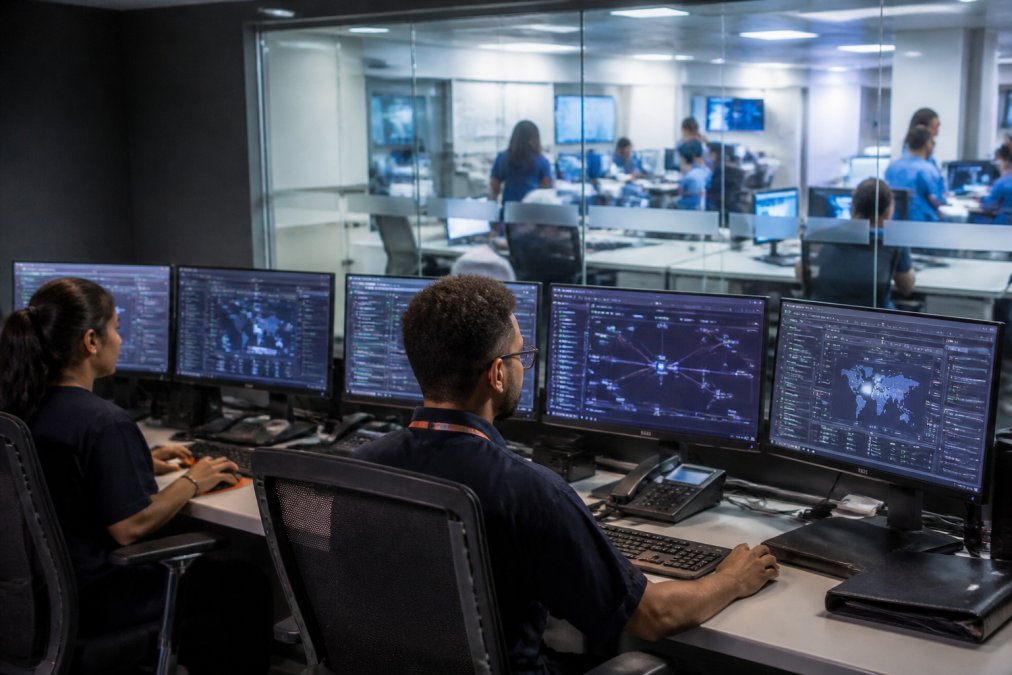
Most healthcare organizations lack the in-house expertise to operate a 24/7 SOC. Recruiting and retaining security analysts is expensive, and turnover is high. Building a credible threat-hunting capability requires years of experience and access to threat intelligence that individual hospitals cannot afford. A managed detection service gives you enterprise-grade security without the burden of staffing a full security operations center.
Regulatory requirements amplify the need. HIPAA mandates that covered entities implement security measures to detect and respond to security incidents. The HIPAA Security Rule requires audit controls, access controls, and integrity controls, all of which depend on detecting unauthorized activity. A documented MDR service strengthens your compliance posture because the vendor maintains logs, incident reports, and forensic evidence that regulators expect to see during audits.
Clinical uptime is non-negotiable. A ransomware attack that encrypts your EHR system doesn't just create a security incident, it stops surgeries, delays diagnoses, and can cost lives. MDR services prioritize speed of response specifically because healthcare cannot tolerate the weeks of downtime that smaller organizations might survive. Threat hunting identifies compromises before ransomware deploys, and incident response teams can isolate affected systems while maintaining access to critical clinical workflows.
HIPAA Compliant Managed Security Services
Any managed detection service you engage must meet HIPAA's Security Rule requirements. This means the vendor must sign a Business Associate Agreement (BAA) that legally binds them to the same privacy and security obligations that apply to your organization. HIPAA requires encryption of data in transit and at rest, access controls, audit logging, and breach notification procedures, your MDR vendor must support all of these.
Compliance automation is a practical benefit. HIPAA requires you to document security controls, maintain audit logs for a minimum of six years, and demonstrate that you've tested your incident response plan annually. An MDR vendor that integrates with your existing infrastructure can automate much of this documentation. Alerts are logged automatically, incident timelines are recorded, and response actions are timestamped, all of which become evidence of your compliance efforts.
Data handling is critical. Your MDR vendor will see patient data as part of normal threat hunting and incident response. They need access to logs, network traffic, and endpoint telemetry that may contain Protected Health Information (PHI). The BAA must explicitly define what data the vendor can access, how long they retain it, and what they do with it after an incident is resolved. Many vendors retain forensic copies for months or years, verify their retention policies match your risk tolerance.
Encryption of communications between your environment and the MDR vendor's monitoring infrastructure is non-negotiable. Data traveling from your network to the vendor's platform must be encrypted in transit. The vendor's storage systems must use encryption at rest. These are baseline requirements, not optional features.
Healthcare Ransomware Protection Strategies
Ransomware is the dominant threat to healthcare organizations because it combines financial incentive with operational impact. An attacker encrypts your EHR database and demands payment, you face a choice between paying millions or restoring from backup (which takes weeks) while patients cannot access their records.
MDR services detect ransomware through behavioral analysis rather than signature matching. Ransomware typically exhibits recognizable patterns: rapid file encryption, mass file deletion, unusual network traffic to command-and-control servers, and lateral movement across your network. An MDR analyst recognizes these patterns and stops the attack before encryption reaches critical systems. Early detection is the difference between stopping ransomware in the reconnaissance phase versus responding after your entire network is encrypted.
Incident response for ransomware requires speed and precision. The first 24 hours are critical. Your MDR team should immediately isolate affected systems, preserve forensic evidence, and assess whether the attacker accessed patient data (which triggers HIPAA breach notification). They should help you identify which backup is clean and safe to restore from. Many organizations have backups that are already compromised because ransomware operators disable backup systems as part of their attack.
Post-incident recovery protocols matter as much as detection. After ransomware is contained, you need to verify that the attacker is fully removed from your network before bringing systems back online. Partial remediation leaves the attacker in place to re-encrypt files days or weeks later. An MDR vendor provides the forensic analysis and verification that your network is truly clean before you restore critical systems.
Key Capabilities: Threat Hunting, Incident Response, and 24/7 Monitoring
Threat hunting is the proactive search for evidence of compromise that automated tools have missed. An analyst examines your network logs, endpoint telemetry, and user behavior looking for anomalies. They might notice a user account accessing files at 3 AM from an unusual location, or a service account making database queries it shouldn't have permission to make. Threat hunting catches attackers in the early stages before they deploy ransomware or exfiltrate data.
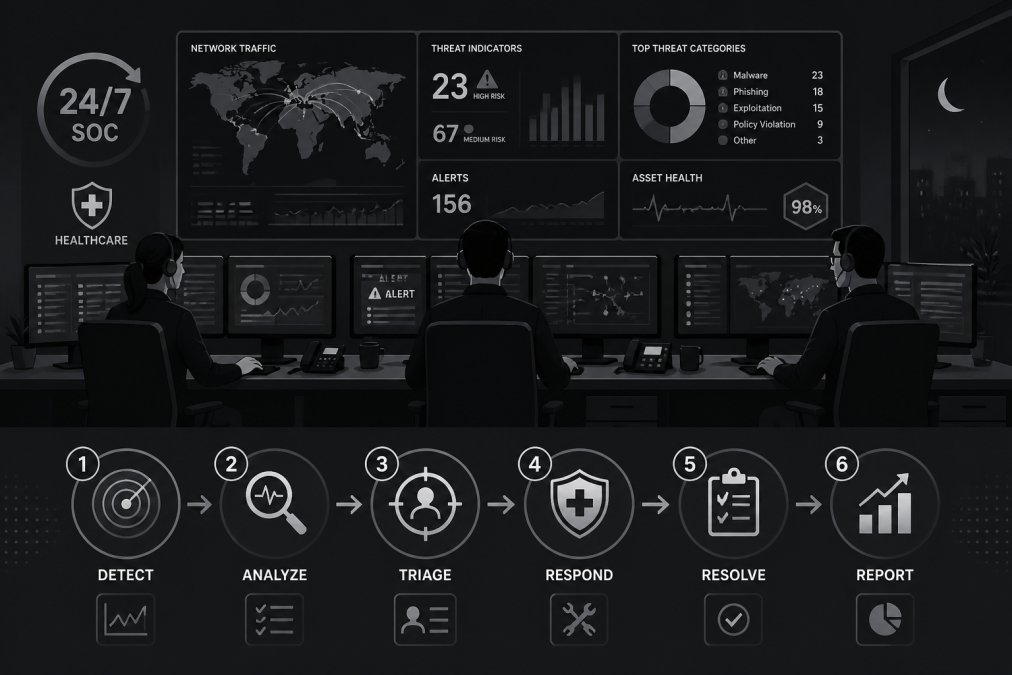
Incident response means immediate action when a threat is confirmed. An MDR analyst doesn't just report that an attack is underway, they coordinate containment. They isolate compromised systems from the network, preserve evidence, and communicate with your incident response team about what's happening in real time. This coordination is critical in healthcare because you need to maintain access to some systems while isolating others. A surgeon needs the EHR available even while you're responding to an attack on your billing system.
24/7 monitoring eliminates the gaps that attackers exploit. Healthcare organizations cannot have security coverage that stops at 5 PM. Attackers work nights and weekends because they know many organizations are understaffed after hours. An MDR service provides continuous monitoring, meaning threats are detected immediately regardless of when they occur. This is especially important for healthcare because patient care doesn't stop at shift change, your security posture shouldn't either.
Log correlation across your entire environment is a capability most organizations cannot build internally. Your EHR generates logs, your network devices generate logs, your cloud infrastructure generates logs, and your endpoints generate logs. Correlating these different sources to find attack patterns requires specialized tools and expertise. An MDR vendor centralizes log collection, applies correlation rules, and alerts your team when suspicious patterns emerge.
Protecting Electronic Health Records and Clinical Uptime
Electronic Health Records are the crown jewels of healthcare networks. They contain complete patient histories, medication records, allergies, and treatment plans. A breach exposes sensitive information that patients cannot change (unlike a credit card number). An attack that corrupts or deletes EHR data creates immediate patient safety risk because clinicians lose access to critical information.
MDR services protect EHR systems through multiple layers. Network monitoring detects unusual access patterns, if someone is exfiltrating large volumes of patient data, the MDR team sees the traffic and stops it. Endpoint monitoring detects ransomware on servers and workstations before encryption spreads. Access controls are validated to ensure that only authorized users and applications can read and modify patient records.
Clinical uptime is the metric that matters most in healthcare. A one-hour outage in a retail business costs money. A one-hour outage in a hospital can cost lives. MDR services prioritize availability as part of incident response. When responding to an attack, the MDR team considers which systems are critical for patient care and protects those systems first, even if it means leaving other systems isolated temporarily.
Recovery time is part of the MDR value proposition. An organization without MDR might spend days or weeks investigating a breach, identifying what was compromised, and restoring systems. An MDR vendor has forensic tools and expertise that compress recovery into hours. This speed directly translates to less downtime and faster return to normal operations.
How to Choose the Right Managed Detection Provider
Evaluate MDR vendors on their specific healthcare experience. A vendor that specializes in financial services or retail might not understand the nuances of healthcare networks, the mix of legacy clinical systems, modern cloud infrastructure, and regulatory requirements. Ask how many healthcare organizations they serve, what size organizations, and what types of healthcare (hospitals, clinics, health systems, ambulatory surgery centers).
Verify that the vendor's team includes analysts with healthcare security experience. MDR quality depends on the expertise of the people reviewing your alerts and hunting for threats. An analyst who understands healthcare networks will recognize suspicious activity that an analyst from another industry might miss. Ask about certifications, look for analysts with CISSP, GIAC, or similar credentials that demonstrate deep security knowledge.
Assess their incident response capability in detail. Ask them to walk you through their process: how quickly do they respond to alerts, how do they communicate with your team, who has authority to take containment actions, and how do they document everything for compliance purposes. A vendor that requires you to approve every containment action will be too slow in an active attack. A vendor that takes actions without informing you might create operational problems.
Understand their threat intelligence sources. Where do they get information about emerging threats? Do they subscribe to threat feeds, participate in information sharing communities, and monitor dark web activity? Threat intelligence is what allows an MDR vendor to recognize new attack patterns quickly. A vendor without strong threat intelligence will miss novel attacks.
Review their reporting and compliance documentation. You need clear incident reports that detail what happened, what was affected, and what actions were taken. You need audit logs that show when threats were detected and how quickly they were contained. You need documentation that demonstrates compliance with HIPAA requirements. Ask for samples of their reports before signing a contract.
| Evaluation Criteria | What to Look For | Why It Matters |
|---|---|---|
| Healthcare Experience | Minimum 50+ healthcare customers, healthcare-specific analysts | Understands clinical systems, HIPAA requirements, and healthcare threat landscape |
| Response Time | Alert to analyst review under 15 minutes, containment actions within 30 minutes | Speed determines whether threats are stopped before damage occurs |
| Threat Hunting | Dedicated threat hunters, not just alert response | Proactive detection catches compromises before they become breaches |
| HIPAA BAA | Explicit BAA with clear data handling terms, encryption requirements | Legal protection and compliance documentation |
| Incident Documentation | Detailed reports, audit logs, forensic evidence preservation | Evidence for breach notifications, regulatory audits, and legal proceedings |
| Integration Capability | Support for your existing tools (EHR, network devices, cloud platforms) | Reduces implementation time and ensures comprehensive monitoring |
Healthcare organizations should prioritize vendors with experience supporting California's healthcare regulatory environment. California has additional privacy requirements beyond HIPAA, including California Consumer Privacy Act (CCPA) provisions that apply to health data. A vendor familiar with California healthcare compliance can help you navigate these overlapping requirements.
Conclusion
Healthcare organizations face security threats that are both more sophisticated and more damaging than threats to other industries. Ransomware operators specifically target hospitals, insider threats compromise sensitive patient data, and supply chain attacks arrive through trusted vendors. Building in-house capability to detect and respond to these threats is expensive and time-consuming.
VegaNext delivers enterprise-grade managed detection and response specifically designed for healthcare networks. Our AI-native platform combines continuous 24/7 monitoring with expert threat hunting and immediate incident response capabilities. We maintain HIPAA-compliant infrastructure with dedicated Business Associate Agreements, handle the complexity of healthcare's mixed legacy and cloud environments, and provide the forensic documentation your compliance team needs. Get started with VegaNext and transform your security posture from reactive incident management to proactive threat detection that protects patient data and clinical uptime.
Frequently Asked Questions
What is managed detection and response (MDR) in healthcare?
Managed detection and response is a security service that combines 24/7 monitoring, threat hunting, and incident response specifically for healthcare environments. MDR uses threat intelligence and log correlation to identify suspicious activity across your network, clinical systems, and Electronic Health Records. When threats are detected, the managed security team responds immediately to contain and remediate the attack before it reaches patient data or disrupts clinical operations.
How does HIPAA compliant managed security services protect patient privacy?
HIPAA compliant managed security services enforce strict data handling, access controls, and audit logging required under the Health Insurance Portability and Accountability Act. These services ensure that all patient data in transit and at rest meets HIPAA encryption standards, maintain detailed compliance automation records for audits, and implement role-based access to Electronic Health Records. Your managed security provider acts as a business associate, signing a Business Associate Agreement (BAA) and maintaining the same compliance obligations as your organization.
Why is healthcare ransomware protection critical for hospitals?
Ransomware attacks on hospitals directly threaten patient safety by disrupting clinical workflows, delaying surgeries, and preventing access to critical medication records. Healthcare ransomware protection strategies include real-time endpoint detection, network segmentation to isolate clinical systems, and automated response protocols that isolate infected devices before spread. Managed detection services use threat actor intelligence and malware analysis to identify ransomware signatures early, allowing incident response teams to block attacks before encryption begins.
What's the difference between a managed security provider and MDR for healthcare?
A managed security provider (MSSP) typically handles infrastructure management, patch management, and firewall administration. Managed detection and response goes deeper: it includes continuous threat hunting, behavioral analysis, and rapid incident response. For healthcare, MDR adds clinical-specific threat intelligence, compliance automation for HIPAA requirements, and security orchestration designed to protect Electronic Health Records and maintain business continuity during attacks.
How does AI-native security improve threat detection in clinical environments?
AI-native security reduces alert fatigue by correlating logs and endpoint signals to identify real threats instead of generating false positives. In clinical settings, AI learns normal behavior for medical devices, EHR access patterns, and network traffic, then flags anomalies that humans would miss. This approach speeds incident response and allows your security team to focus on genuine threats rather than investigating hundreds of low-value alerts daily.
What happens after a breach is detected, how does post-incident recovery work?
Post-incident recovery protocols begin immediately after detection. Your managed detection team isolates affected systems, preserves forensic evidence, and contains the threat. They then work with your clinical teams to restore systems in priority order: critical patient care systems first, then administrative systems. Throughout recovery, they document all actions for breach notification requirements and regulatory reporting, ensuring your organization meets state and federal notification timelines.
This article was written using GrandRanker