 how-to
How to Reduce Security Alert Fatigue: A Step-by-Step Guide
Table of Contents
- What Is Alert Fatigue and Why It Threatens Your SOC
- Understanding Cybersecurity Analyst Burnout Symptoms
- Step 1: Audit Your Current Alert Volume and False Positives
- Step 2: Implement a SIEM Alert Tuning Guide for Your Environment
- Step 3: Deploy Security Automation Tools for Alert Fatigue Reduction
- Step 4: Reduce False Positives in SIEM Through Validation
- Step 5: Prioritize Critical Alerts and Establish Playbooks
- Common Mistakes to Avoid When Reducing Alert Fatigue
Last Updated: August 8, 2026
What Is Alert Fatigue and Why It Threatens Your SOC
Alert fatigue occurs when security operations center analysts receive more alerts than they can meaningfully investigate, leading to missed threats and burnout. When detection systems generate hundreds or thousands of daily alerts, the signal-to-noise ratio collapses and analysts stop trusting the systems. Critical incidents slip through unnoticed.
According to Gartner's 2026 cybersecurity operations research, organizations with uncontrolled alert volumes experience mean time to respond (MTTR) stretching from hours to days, with measurable drops in analyst retention. The challenge isn't generating more alerts, modern detection engineering produces them at scale. The challenge is making alerts actionable. This guide walks through a systematic approach to reduce alert fatigue by tuning detection, automating triage, and restructuring team prioritization.
Understanding Cybersecurity Analyst Burnout Symptoms
Cybersecurity analyst burnout manifests as decision fatigue by mid-shift, emotional exhaustion from false alarms, and helplessness when unable to investigate alerts fast enough.
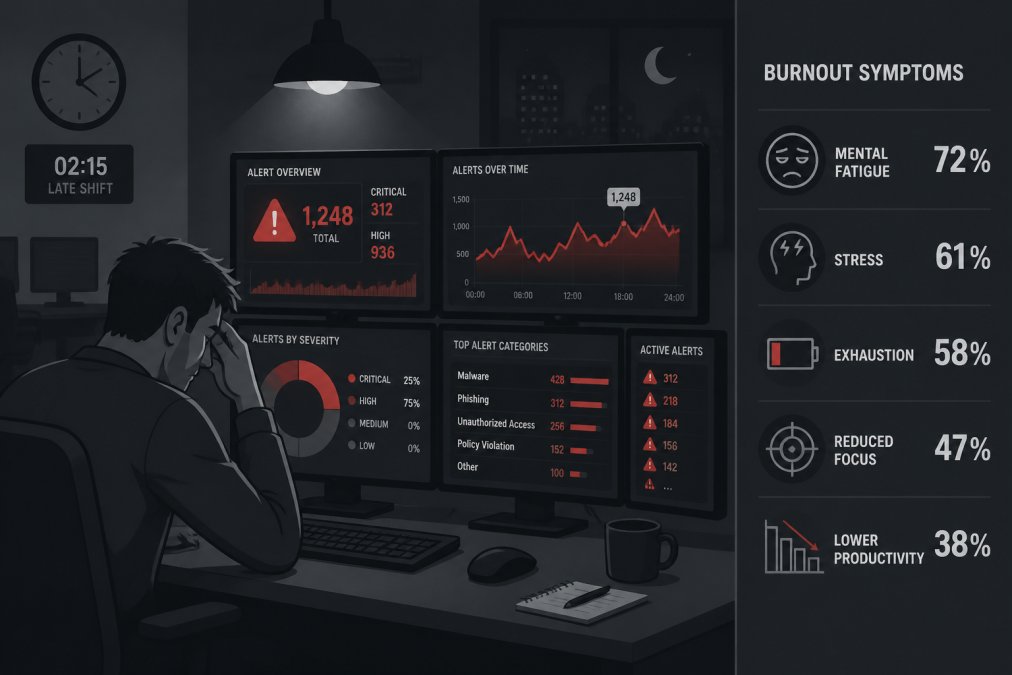
Alert noise leads to decision paralysis: which alerts matter? Without clear prioritization, analysts treat all alerts as equally urgent or ignorable. Within weeks, this produces observable burnout markers, missed deadlines, poor documentation, and accelerated turnover. Your most experienced analysts leave first.
The operational cost is severe. Recruiting and training a SOC analyst takes 6-12 months to reach full productivity. Replacing an experienced analyst costs tens of thousands in direct hiring, onboarding, and lost knowledge. Alert fatigue creates a vicious cycle: burnout drives turnover, reduced capacity increases per-analyst alert load, and alert load accelerates burnout further.
Treating analyst burnout as a morale problem solvable through compensation is a common mistake. The real issue is workload structure. If your systems generate 2,000 daily alerts and your team can investigate 200, no compensation fixes the underlying math. You must reduce alert volume or automate triage.
Step 1: Audit Your Current Alert Volume and False Positives
Start by measuring what you actually have. Alerts scatter across multiple tools, your SIEM, endpoint detection and response (EDR), network sensors, and third-party integrations.
Conduct a 7-day audit across all detection sources. Record total alerts per day, alerts that led to confirmed incidents, and false positives for each source. This reveals your false positive ratio; organizations typically find 70-90% of alerts are false positives.
Categorize alerts by severity level and ask your team which severity levels warrant investigation. This often reveals severity inflation, when 80% of alerts are marked "high" or "critical," analysts learn that critical doesn't mean critical and deprioritize accordingly. Recalibrate severity assignments to match reality.
Document your findings in a baseline report. You need this baseline to measure improvement later.
Step 2: Implement a SIEM Alert Tuning Guide for Your Environment
Alert tuning adjusts detection rules to fire only on genuinely suspicious activity. Most organizations deploy vendor rules without adjusting them for their specific environment, causing excessive false positives.
Your environment is unique. Your network baseline, user behavior patterns, and infrastructure mix (cloud, on-premises, hybrid) differ from other organizations. Detection rules must be tuned to your context.
Start with your worst-performing detection source from the audit. Don't try to tune everything at once.
Adjust Detection Thresholds
Detection thresholds determine when rules fire. A threshold like "alert on 5 failed authentications in 10 minutes" works fine if users rarely fail authentication, but fails if legacy applications retry aggressively, generating hundreds of false alerts daily.
Review rules generating high false positive rates and adjust thresholds accordingly. "5 failed logins in 10 minutes" might become "15 failed logins in 10 minutes." Document your adjustments and test them against historical data by replaying past events through adjusted rules.
Create Context-Based Suppression Rules
Some alerts are technically valid but contextually irrelevant. A user accessing sensitive data at 3 AM triggers an alert, but if that user is on-call, the alert is a false positive in context.
Suppression rules disable alerts for documented legitimate activity. For example: "Suppress alerts for service accounts accessing data repositories outside business hours, because service accounts run batch jobs overnight." Every suppression rule needs justification to prevent suppression from becoming a dumping ground for misunderstood alerts.
AI-Driven Pattern Analysis for Alert Tuning
AI-driven pattern analysis can identify which alerts correlate with actual incidents versus isolated events, automatically calibrating detection thresholds to your environment's baseline.
Step 3: Deploy Security Automation Tools for Alert Fatigue Reduction
Manual investigation of every alert is unsustainable. Security automation tools (SOAR platforms) handle routine triage automatically, eliminating tedious work without adding security value.
A typical automated triage workflow: an alert fires, the automation tool enriches it with context (Is the source IP malicious? Does the user have a history of this behavior? Is the target critical?), then dismisses clearly benign alerts, escalates clearly malicious ones, or routes others to analysts for investigation.
This reduces analyst workload dramatically. Analysts focus on alerts requiring actual investigation.
Select automation tools that integrate with your SIEM. Common playbooks include enriching IPs against threat intelligence, checking user accounts against your identity system, correlating related alerts into incidents, and automatically running containment actions for confirmed high-severity incidents.
Start with 3-5 high-impact playbooks rather than attempting to automate everything.
Step 4: Reduce False Positives in SIEM Through Validation
After tuning thresholds and deploying automation, validate that changes improved the situation. Run a second 7-day audit identical to your first. Compare results: did alert volume decrease? Did false positive ratio improve? Did analysts report less fatigue?
A healthy target is 200-400 daily alerts with false positive rates below 30%. Some mature organizations achieve rates below 10%.
Document and share validation results with your team. Analysts need to see their feedback produces measurable improvement, rebuilding trust in detection systems. Use validation data to identify remaining problem areas requiring additional tuning.
Step 5: Prioritize Critical Alerts and Establish Playbooks
Once you've reduced noise, ensure your team investigates the most important alerts first.
Create an alert prioritization framework ranking alerts by potential impact, likelihood, and context. A critical alert, "Lateral movement detected from compromised workstation to domain controller", ranks high on all three dimensions. A low-priority alert, "User accessed file share outside normal hours", ranks low.
Establish playbooks for highest-priority alert categories. A playbook documents procedures for investigating and responding to specific alert types. For lateral movement, your playbook might be: (1) confirm the source system is compromised, (2) immediately isolate the domain controller, (3) notify incident response, (4) begin forensic investigation.
Playbooks accelerate response and standardize quality. In California, many organizations have discovered playbooks also satisfy compliance requirements like HIPAA and PCI-DSS, which mandate documented incident response procedures.
Common Mistakes to Avoid When Reducing Alert Fatigue
Organizations typically make predictable errors when addressing alert fatigue.
The first mistake is disabling detection entirely. Overwhelmed teams disable worst-offending rules, eliminating alert noise but also eliminating detection capability. Never disable detection; tune it instead.
The second mistake is treating alert tuning as a one-time project. Detection tuning requires ongoing iteration as your environment changes, new applications deploy, and threat actors evolve tactics.
The third mistake is failing to involve analysts in tuning. Analysts see patterns automation can't detect and know which alerts are consistently false positives.
A fourth mistake is deploying automation without understanding what it's automating. Automation should accelerate investigation, not hide problems.
The fifth mistake is measuring success by alert volume alone. Reducing alerts from 2,000 to 1,000 daily feels like progress, but if false positive rate stayed the same, you've reduced detection coverage. Measure alert volume, false positive rate, analyst satisfaction, and MTTR.
Small teams often assume alert fatigue only affects large enterprises. Alert fatigue affects organizations of any size. A 10-person IT team receiving 500 daily alerts is as overwhelmed as a 50-person team receiving 5,000.
Alert fatigue is solvable through systematic work. Start with measurement, audit your current state, then tune detection sources, implement automation for routine triage, and establish clear prioritization and playbooks. Organizations following this approach consistently report reduced analyst burnout, faster incident response, and improved security outcomes.
VegaNext helps enterprise organizations implement this systematic approach through AI-driven alert optimization and managed detection services. Our platform automates detection tuning, correlates alerts across your infrastructure, and prioritizes critical threats automatically. If your team is drowning in alert noise, contact VegaNext to explore how AI-native managed services can restore signal to your security operations.
Frequently Asked Questions
How does alert fatigue develop in a security operations center?
Alert fatigue develops when SOC analysts receive excessive alerts, many of them false positives, without effective prioritization or automation. As alert volume grows, analysts become desensitized to warnings, missing genuine threats while spending hours on noise. This cycle increases mean time to respond (MTTR), degrades security posture, and drives burnout. The root causes include poorly tuned detection thresholds, lack of context in alerts, and insufficient automation for triage and suppression.
What is the connection between alert fatigue and cybersecurity analyst burnout symptoms?
Alert fatigue directly triggers burnout. Analysts exposed to constant, non-actionable alerts experience decision fatigue, reduced job satisfaction, and chronic stress. Common burnout symptoms include irritability, difficulty concentrating, high sick leave, and ultimately, staff turnover. Organizations with high alert-to-threat ratios see faster analyst burnout and higher recruitment costs. Addressing alert fatigue through tuning, automation, and workload management protects both security operations and team retention.
Can security automation tools really reduce alert fatigue, or do they just create more noise?
When properly configured, security automation tools significantly reduce alert fatigue by automating triage, applying context, and suppressing known false positives. SOAR platforms and detection-as-code approaches enable analysts to focus on high-confidence threats. However, poorly tuned automation can increase noise. Success requires starting with a clear audit of your alert baseline, defining playbooks before deployment, and validating that automation reduces alert volume without masking real threats. Post-tuning measurement is essential.
How long does it take to see results from alert fatigue reduction efforts?
Initial improvements appear within 2-4 weeks of threshold tuning and basic suppression rule deployment. More significant gains, 30-50% reduction in false positives, typically emerge over 8-12 weeks as detection-as-code practices mature and teams refine playbooks. Full operational efficiency, including improved MTTR and analyst retention, develops over 6 months as organizational processes stabilize. Small teams often see faster results than large enterprises due to simpler environments and faster iteration cycles.
This article was written using GrandRanker