 how-to
How to Choose an AI Automation Company
Table of Contents
- Define Your Automation Goals Before Vendor Search
- Build Your AI Automation Agency Vetting Checklist
- Understand the Cost of AI Automation Services
- Evaluate AI Integration Timeline and Complexity
- Common Pitfalls That Derail AI Automation Implementations
- How to Choose an AI Automation Company That Fits Your Infrastructure
- Measuring ROI and Success Metrics
- Frequently Asked Questions
Last Updated: September 21, 2026
How to choose an AI automation company is one of the most critical decisions a modern enterprise makes. The wrong vendor choice can derail your digital transformation, waste months of integration time, and leave your infrastructure more fragile than before. The right one becomes a force multiplier for your operations.
This guide from VegaNext walks you through a framework for evaluating AI automation vendors. We've helped healthcare enterprises, financial services firms, supply chain operations, and automotive dealerships navigate this decision. The patterns are consistent: teams that follow a structured vetting process avoid costly mistakes, while those that skip steps often end up replacing their solution within 18 months.
Define Your Automation Goals Before Vendor Search
Before you talk to a single vendor, you need clarity on what you're actually trying to automate. Many teams jump straight to "we need AI automation" without defining the problem they're solving.
Start here: What specific processes are slowing you down? Are you drowning in alert noise from your security tools? Is your infrastructure team spending 40 hours a week on repetitive maintenance tasks? Does your supply chain visibility break down every time a third-party vendor changes their systems?
Write down 3-5 concrete pain points. For each one, estimate how much time or money it costs you annually. A healthcare CISO might note: "Alert fatigue from our SOC is causing 15% of critical alerts to be missed." A supply chain director might say: "Manual reconciliation of third-party integrations takes 60 hours per month."
Next, define success metrics. Don't just say "improve efficiency." Say: "Reduce mean time to respond to security alerts from 4 hours to 45 minutes" or "Automate 80% of routine infrastructure tasks, freeing our team for strategic work."
These goals become your filter. Every vendor you evaluate must clearly address these specific problems. If a vendor's solution doesn't map to your defined goals, eliminate them immediately.
Build Your AI Automation Agency Vetting Checklist
This is where most teams fail. They evaluate vendors on surface features instead of the factors that actually determine success.
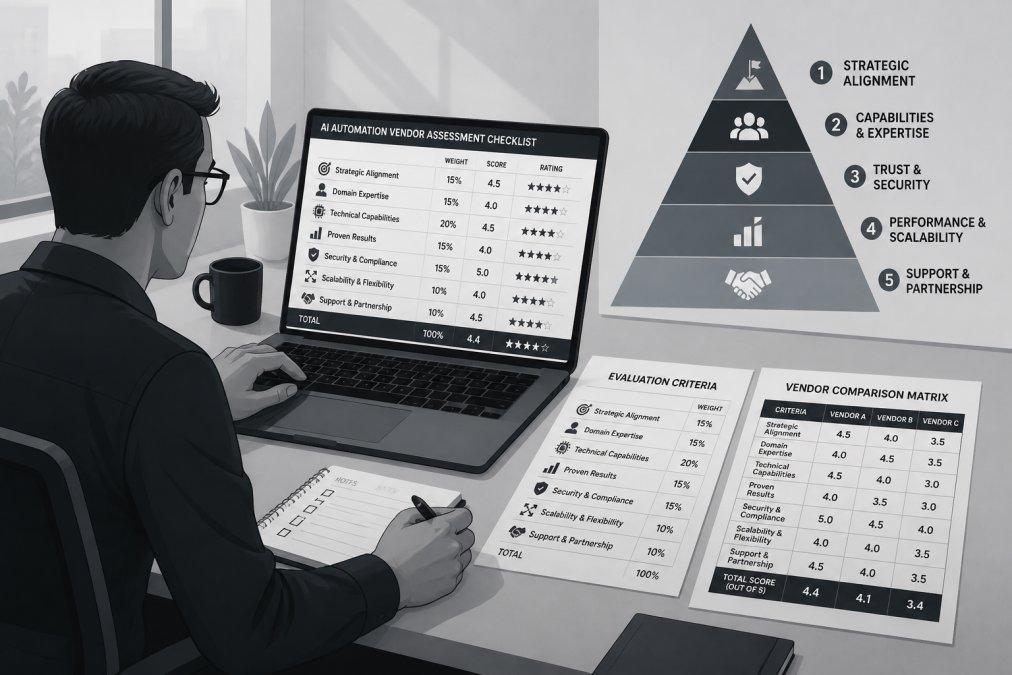
A strong vetting checklist has three sections: technical capability, operational maturity, and industry experience.
Technical Capability Assessment
Can the vendor actually do what they claim? This requires going deeper than their marketing materials.
Ask for a technical architecture review. How does their platform ingest data from your systems? Can it handle your current infrastructure mix (cloud, on-premises, hybrid)? What happens when you throw 10 million events per day at it?
Request a proof-of-concept with your actual data. Not their demo data. Your data. A vendor confident in their platform will do this. One that dodges the request is showing you something.
Check their integration roadmap. If you are using existing tools for SOC operations, does their platform integrate cleanly with them, or does switching to them require ripping out your existing tools? Integration debt is real. It's the reason teams get stuck.
Ask about false positive rates. This matters especially in security automation. A platform that generates more alerts than it resolves isn't automation, it's noise amplification. Request case studies from similar companies showing actual false positive reduction, not just promised reduction.
Operational Maturity and Support Structure
Technical capability means nothing if the vendor can't support you at 2 a.m. on a Sunday when something breaks.
Find out who answers the phone. Is it a real person or an automated system? What's their average response time for critical issues? For a healthcare enterprise or financial services firm, "critical" means something is actively harming your business. You need humans, not bots.
Ask about their 24/7 managed service. What does it actually include? Are they monitoring your systems proactively, or do they only respond when you call? The best vendors show you their monitoring dashboard and explain how they detect problems before you do.
Check their onboarding process. How long does implementation typically take? What's their success rate? If they tell you "most implementations take 6 months," ask why. Is that complexity inherent to your environment, or is their platform just difficult to deploy?
Request references from companies similar to yours. Not their best customers, ask for three recent implementations in your industry. Call them. Ask specifically: "What surprised you about the implementation? What would you do differently?"
Industry Experience and Reference Validation
A vendor that's solved your exact problem before is worth more than one learning on your dime.
Look for case studies specific to your industry. Healthcare automation is different from supply chain automation. A vendor strong in one may be weak in the other. If they don't have references in your vertical, that's a red flag.
Ask about their experience with your specific pain points. If alert fatigue is your problem, they should have case studies showing measurable alert reduction in healthcare SOCs. If supply chain visibility is your issue, they should reference third-party integration automation in logistics.
Verify their claims. Don't accept "we've reduced alert fatigue for 50+ healthcare clients." Ask for three of those clients by name. Call them. Ask what their alert volume looked like before and after. Numbers matter.
Understand the Cost of AI Automation Services
Pricing varies significantly based on scope, infrastructure complexity, and service level. Rather than guessing, contact VegaNext directly for a quote tailored to your environment. Pricing depends on factors like your data volume, number of integrations, and whether you need 24/7 managed services.
When evaluating cost, don't optimize for the lowest price. Optimize for total cost of ownership. A cheaper platform that requires six months of implementation and a dedicated internal team to maintain is more expensive than a higher-priced platform that includes managed services and launches in six weeks.
Ask vendors to break down their costs. What's included in the base fee? What costs extra? Do they charge per event, per integration, or per user? Understanding their pricing model prevents surprises later.
Evaluate AI Integration Timeline and Complexity
Integration timeline often determines whether an AI automation project succeeds or fails. Teams underestimate this consistently.
Ask for a detailed implementation plan. Not a vague "12-week implementation." You need: week 1-2 (discovery and architecture), week 3-4 (data integration testing), week 5-8 (automation workflow build), week 9-10 (testing and refinement), week 11-12 (go-live and monitoring).
Understand what blocks progress. If your infrastructure is a mess of legacy systems, cloud platforms, and on-premises databases, integration gets harder. A vendor experienced with messy infrastructure will build this complexity into their timeline. One that promises fast deployment despite your complexity is either inexperienced or overselling.
Ask about rollout strategy. The best vendors don't go all-in on day one. They start with one critical workflow, prove the value, then expand. This reduces risk and gives your team time to learn.
Common Pitfalls That Derail AI Automation Implementations
Most failed AI automation projects fail for the same reasons. Knowing these patterns helps you avoid them.
Underestimating change management. Automation changes how teams work. Your SOC analysts lose their alert triage task. Your infrastructure team loses their routine maintenance work. If you don't plan for this transition, you'll face resistance that sabotages the project. Budget time and resources for training and role realignment.
Choosing based on feature lists instead of fit. A platform with 50 features you don't need is worse than one with 10 features that perfectly solve your problem. Evaluate based on your specific goals, not comprehensive feature counts.
Skipping the proof-of-concept. A POC with your actual data and workflows surfaces integration issues early. Skipping it means discovering these problems during full implementation, when they're expensive to fix.
Not accounting for your infrastructure complexity. A vendor that's optimized for cloud-native environments may struggle with your hybrid infrastructure. Complexity isn't a reason to avoid automation, it's a reason to choose a vendor experienced with it.
How to Choose an AI Automation Company That Fits Your Infrastructure
Your infrastructure is unique. Your vendor choice should reflect that reality.
If you run primarily on-premises infrastructure, you need a vendor experienced with on-prem deployment and management. If you're hybrid (some cloud, some on-prem), you need someone who's solved that integration problem before.
Ask directly: "How many companies like us have you implemented for? What was their infrastructure mix? How long did it take?"
For healthcare enterprises in Los Angeles and across California, regulatory requirements add complexity. Your vendor needs to understand HIPAA compliance implications of their automation. For financial services, they need to understand SOX and SEC requirements.
In supply chain operations, third-party risk is paramount. Your vendor's automation platform needs to integrate with your supplier management systems and detect anomalies in third-party behavior.
Measuring ROI and Success Metrics
Before you sign, agree on how you'll measure success. This prevents disputes later and gives you a clear way to evaluate whether the vendor delivered.
Set a timeline for measurement.
Frequently Asked Questions
What should I look for when evaluating an AI automation company?
Focus on three areas: technical depth (can they handle your specific systems and use cases), operational maturity (do they have 24/7 support and clear SLAs), and proven experience in your industry. Request references from companies similar to yours, review their approach to integration timelines, and confirm they understand your legacy infrastructure constraints. Ask how they measure success and what ROI metrics they track.
How do I verify the technical expertise of an AI automation company?
Request detailed case studies or whitepapers showing how they've solved problems in your industry. Ask about their team's certifications, years of experience with your specific tech stack, and their approach to alert tuning and false-positive reduction. Have them walk you through their architecture and how they'd integrate with your existing systems. Legitimate vendors will provide technical references you can contact directly.
What's a realistic AI integration timeline for my organization?
Timeline depends on infrastructure complexity. Organizations with modern cloud-native setups typically see 2-4 months for initial deployment. Those with significant legacy systems, multiple cloud platforms, or on-premises infrastructure should budget 4-6 months or longer. Reputable AI automation companies will assess your environment first and provide a detailed timeline with milestones. Beware of vendors promising rapid implementations without understanding your technical landscape.
How should I approach the cost of AI automation services?
Costs vary based on infrastructure size, complexity, deployment scope, and support level. Rather than comparing flat rates, evaluate total cost of ownership: include implementation, training, ongoing management, and the cost of your current manual processes. Request transparent pricing models and ask how costs scale as you expand. Get quotes from multiple vendors and compare what's included in each tier before deciding.