 listicle
Guardz Alternative for Managed Security: Top 8 Picks
Table of Contents
- Why MSPs Are Searching for a Guardz Alternative for Managed Security
- How We Evaluated Each Guardz Alternative for Managed Security
- Quick Comparison: MSP Security Stack Comparison at a Glance
- Best Cybersecurity Tools for MSPs: Platform-by-Platform Breakdown
- VegaNext: AI-Native Managed Security for Enterprise Complexity
- Huntress Managed EDR: Human-Led SOC With Predictable MSP Pricing
- CrowdStrike Falcon: Cloud-Native Endpoint Protection at Scale
- Sophos Intercept X: Deep Learning Detection for Multi-Tenant MSPs
- Arctic Wolf: Named Concierge Security Team With Breach Warranty
- Blackpoint Cyber: Autonomous Threat Response With 24/7 SOC
- Datto RMM and Kaseya VSA: RMM-First Platforms With Security Layers
- Unified Cybersecurity Platform Features: What Separates Full-Stack From Point Solutions
- Migration and Implementation Friction: The Cost Competitors Don't Discuss
- Total Cost of Ownership and Automation vs. Human Oversight
- Scalability, Zero Trust, and Security Posture for SMBs and Enterprises
- Frequently Asked Questions
Last Updated: August 4, 2026
Finding a genuine guardz alternative for managed security is harder than it looks. Most comparison guides list the same five platforms with identical feature bullets. The VegaNext team has worked through this evaluation with enterprise clients across healthcare, financial services, and supply chain. Below, we break down eight platforms that MSPs are actually deploying in 2026, with honest assessments of where each one excels and where it falls short.
Why MSPs Are Searching for a Guardz Alternative for Managed Security
The search for a guardz alternative accelerated as MSP client bases matured beyond SMB-only profiles. Many MSPs now carry mixed books: some clients need basic endpoint protection, others need 24/7 managed detection and response with identity coverage and cloud security monitoring. A platform built around a single customer archetype creates friction at both ends of that spectrum.
When your clients span healthcare enterprises with HIPAA obligations, financial services firms under FINRA oversight, and automotive dealerships protecting digital transaction systems, a point solution becomes a liability. According to CISA's guidance on managed security services for critical infrastructure, organizations managing critical infrastructure need security operations covering endpoint, identity, cloud, and network layers simultaneously. The other driver is alert fatigue, security dashboards that surface every low-fidelity signal without triage burn out security teams.
How We Evaluated Each Guardz Alternative for Managed Security
Evaluation Criteria: What Actually Matters for MSP Security Stacks
A useful MSP security stack comparison requires criteria that map to operational reality, not marketing claims. We evaluated each platform across six dimensions:
| Criterion | Why It Matters for MSPs |
|---|---|
| Unified platform coverage | Endpoint + identity + cloud + email in one console |
| Multi-tenant architecture | Separate client environments, shared management overhead |
| AI-driven threat detection | Automated triage vs. manual alert review |
| Human SOC backing | 24/7 analyst coverage for escalations |
| MSP pricing model | Per-endpoint or per-seat billing, monthly flexibility |
| Migration and onboarding friction | Time-to-value, API integration complexity |
Platforms that score well on only two or three criteria are point solutions. The best cybersecurity tools for MSPs score across all six.
Quick Comparison: MSP Security Stack Comparison at a Glance
| Platform | Core Strength | SOC Model | MSP Pricing | Best For |
|---|---|---|---|---|
| VegaNext | AI-native full-stack MDR | AI + human experts | Custom enterprise | Enterprise complexity, mixed infrastructure |
| Huntress Managed EDR | Human-led SOC, SMB EDR | 24/7 human SOC | ~$2.50-$3.50/endpoint/mo | SMB-heavy MSP books |
| CrowdStrike Falcon | Cloud-native EDR + XDR | OverWatch threat hunting | From $59.99/device/yr | Mid-market, security-led MSPs |
| Sophos Intercept X | Deep learning endpoint | Sophos MDR add-on | From $28/user/yr | Multi-tenant MSPs upgrading from basic AV |
| Arctic Wolf | Concierge SOC team | Named security engineers | From $295/employee/yr | Mid-market orgs wanting turnkey SOC |
| Blackpoint Cyber | Autonomous threat response | 24/7 SOC + autonomous | Contact for pricing | Clients needing rapid autonomous containment |
| Datto RMM | RMM-first with security layers | No native SOC | Contact for pricing | MSPs prioritizing device management |
| Kaseya VSA | Unified RMM + patch + AV | No native SOC | Contact for pricing | MSPs focused on patch automation |
Best Cybersecurity Tools for MSPs: Platform-by-Platform Breakdown
VegaNext: AI-Native Managed Security for Enterprise Complexity
VegaNext is an AI-native managed service provider combining enterprise-grade cybersecurity with intelligent automation and infrastructure management across hybrid environments. For MSPs serving clients with legacy systems, cloud workloads, and on-premises infrastructure running in parallel, this architectural approach matters more than any single feature.
VegaNext builds AI automation into the core service delivery model rather than bolting it onto existing detection pipelines. Threat detection, incident response workflows, and infrastructure management operate from a shared intelligence layer, reducing onboarding timelines that plague most enterprise security migrations.
Pros:
- AI-native architecture, not AI-augmented legacy tooling
- Full-stack managed service: cybersecurity, automation, and infrastructure in one engagement
- Built for enterprise complexity with mixed infrastructure environments
Cons:
- Pricing requires a custom quote; not suited for self-serve, low-touch deployments
- Best fit is enterprise-scale clients, not the smallest SMB accounts
Huntress Managed EDR: Human-Led SOC With Predictable MSP Pricing
Huntress built its reputation on one clear proposition: human analysts triage every alert before it reaches the MSP. That single design decision changes the operational experience for MSP teams managing dozens of client environments simultaneously.
The platform covers managed EDR for Windows, Mac, and Linux endpoints, managed identity threat detection for Microsoft 365 and Active Directory, managed SIEM, and security awareness training. Pricing runs approximately $2.50 to $3.50 per endpoint per month at MSP partner rates, with a 50-agent minimum.
Pros:
- Human SOC eliminates noise before it reaches the MSP, directly addressing alert fatigue
- Predictable per-endpoint pricing designed for MSP margin models
- Fast deployment with strong partner support
Cons:
- No native network or cloud detection in the core offering
- 50-agent minimum excludes the smallest client accounts
CrowdStrike Falcon: Cloud-Native Endpoint Protection at Scale
CrowdStrike Falcon delivers top-tier detection capability with a cloud-native single-agent architecture and no on-premises management overhead. The Falcon OverWatch managed threat hunting service provides 24/7 human-led hunting at higher tiers.
Falcon Go starts at $59.99 per device per year, though MSPs running mid-market clients typically operate at higher tiers. Falcon Complete, the fully managed MDR offering, is custom-quoted. Multi-tenant management runs through Falcon Flight Control.
Pros:
- Top-tier threat detection and threat hunting
- Lightweight cloud-native agent with no on-premises management
- XDR capabilities extend coverage beyond endpoint
Cons:
- Expensive and complex for SMB-heavy client portfolios
- Falcon Complete pricing requires custom negotiation
Sophos Intercept X: Deep Learning Detection for Multi-Tenant MSPs
Sophos Intercept X uses a deep learning engine that evaluates file characteristics rather than relying solely on signature matching, improving detection of novel malware variants. CryptoGuard technology actively reverses ransomware file encryption in progress.
The Sophos Central Partner console is purpose-built for multi-tenant MSP operations. MSP Connect Flex billing is usage-based with automatic volume discounts. Intercept X Advanced starts at $28 per user per year, though MSP pricing varies by partner tier and volume.
Pros:
- Deep learning detection handles zero-day and novel threats well
- Multi-tenant console purpose-built for MSP management workflows
- Usage-based MSP billing reduces financial risk on smaller accounts
Cons:
- Pricing requires partner negotiation
- No free tier or trial available
Arctic Wolf: Named Concierge Security Team With Breach Warranty
Arctic Wolf assigns every client a named Triage Security Engineer and Concierge Security Engineer who conduct monthly security operations reviews and quarterly risk-posture briefings. The platform covers managed detection and response, managed risk with continuous vulnerability scanning, and cloud detection and response for IaaS and SaaS applications. Pricing starts at approximately $295 per employee per year for the MDR tier. The breach warranty of up to $3 million with qualifying bundles is a meaningful differentiator for risk-conscious clients.
Pros:
- Named security team creates accountability and continuity
- Technology-agnostic platform works with existing security tool investments
- Breach warranty adds concrete risk transfer
Cons:
- Per-employee pricing becomes expensive at enterprise scale
- EDR licenses are an additional cost outside the core offering
Blackpoint Cyber: Autonomous Threat Response With 24/7 SOC
Blackpoint Cyber's primary differentiator is autonomous response speed. When the platform detects a threat, it isolates affected endpoints and identities immediately, before lateral movement can occur. Coverage spans endpoint MDR, identity threat detection, cloud security monitoring, and network detection and response.
Pros:
- Autonomous containment reduces dwell time without waiting for human approval
- Comprehensive endpoint and identity coverage
- 24/7 SOC provides continuous human oversight alongside automation
Cons:
- Pricing requires direct sales engagement
- Advanced autonomous features may require process adjustment for clients accustomed to manual approval workflows
Datto RMM and Kaseya VSA: RMM-First Platforms With Security Layers
Datto RMM and Kaseya VSA are remote monitoring and management tools that have added security capabilities, not security platforms that added management features. Datto RMM provides real-time device monitoring with automated responses, patch management, and ransomware detection. Kaseya VSA adds unified console management for AV/AM deployment, automated patch management, and ransomware detection.
Both require contacting sales for pricing and neither includes a native SOC. For MSPs whose security requirements extend beyond endpoint and patch management into identity, cloud, and threat hunting, these platforms need significant supplementation from dedicated security tools.
Best use case: MSPs where operational efficiency and device management are the primary value driver, and security is handled through integrated third-party tools.
Unified Cybersecurity Platform Features: What Separates Full-Stack From Point Solutions
A unified cybersecurity platform delivers endpoint protection, identity coverage, cloud security, email security, and threat intelligence from a single management console with shared telemetry across all layers. Platforms that bolt modules together without sharing detection context are bundled, not unified.
Endpoint Detection and Response and Identity Coverage
Endpoint detection and response is the foundation of modern managed security, but EDR alone covers only one attack surface. Identity-based attacks, particularly credential theft targeting Microsoft 365 and Active Directory, mean identity threat detection and response is now baseline. Platforms handling both EDR and identity in a single telemetry stream detect lateral movement patterns that siloed tools miss entirely.
According to NIST's guidance on zero trust architecture, effective zero trust implementation requires continuous verification across all access points, demanding integrated endpoint and identity monitoring.
Email Security, Phishing Simulation, and Cloud Security
Phishing remains the most common initial access vector for enterprise breaches. Platforms combining email security, phishing simulation for security awareness training, and cloud security monitoring address the full attack chain from initial compromise through lateral movement to data exfiltration. SaaS security and cloud-native monitoring are non-negotiable for clients running Microsoft 365, Google Workspace, and IaaS workloads.
Migration and Implementation Friction: The Cost Competitors Don't Discuss
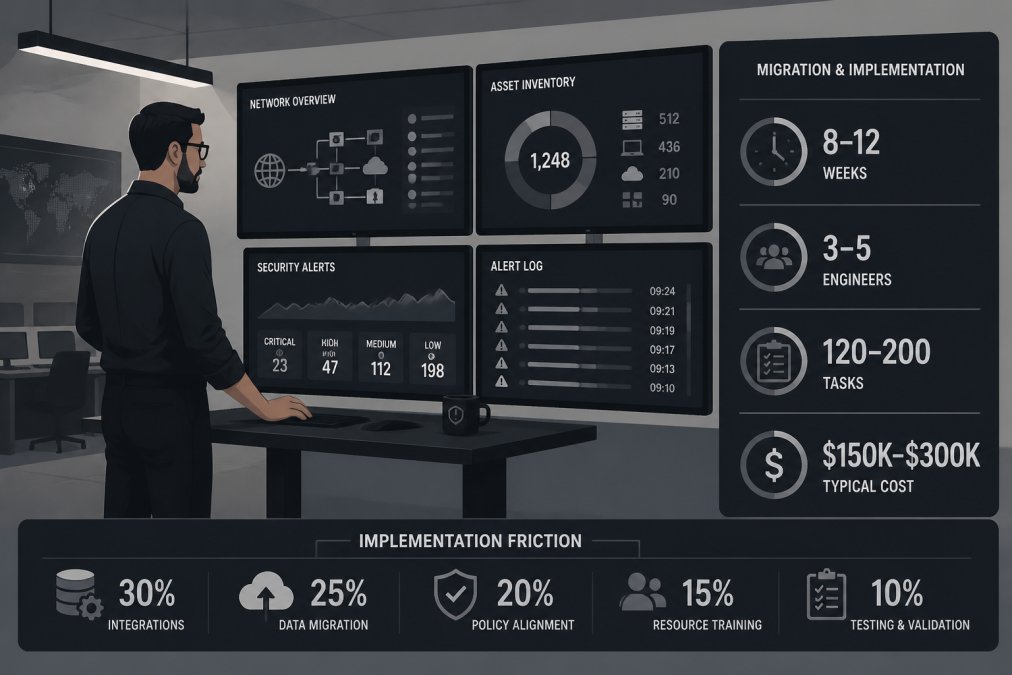
Migration friction is the hidden cost in every platform evaluation. The real question is not "what does this platform cost per month?" but "what does it cost to get from where we are now to fully operational?"
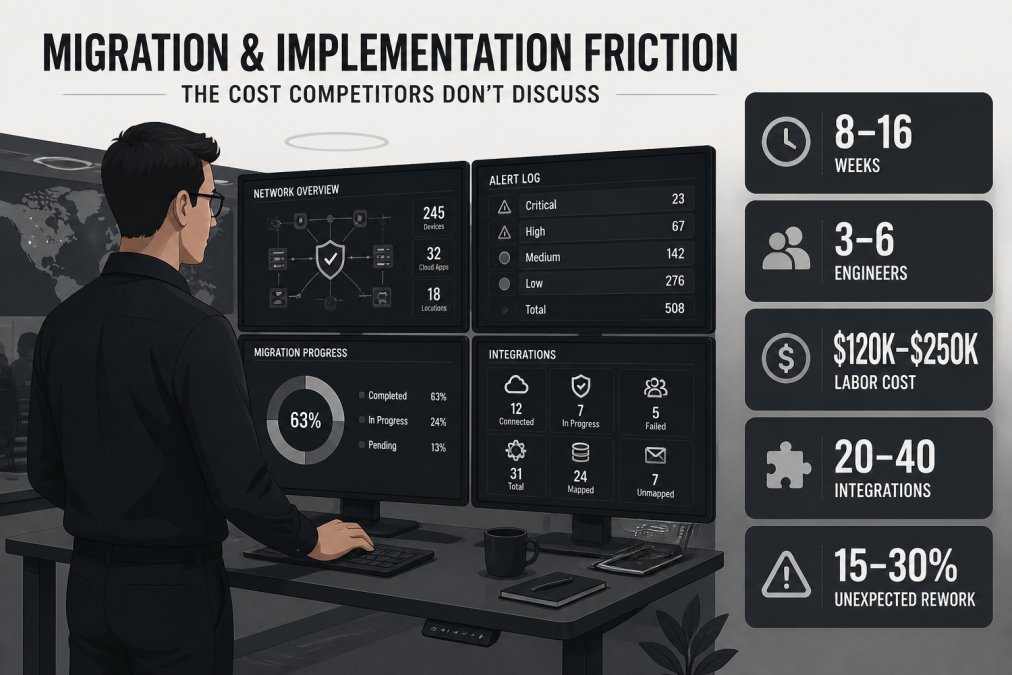
For enterprise clients with mixed legacy systems, on-premises infrastructure, and cloud workloads, migration timelines can stretch from weeks to months depending on API integration complexity.
Vendor Lock-In Risks and API Integration Considerations
Vendor lock-in takes two forms: technical lock-in through proprietary data formats and limited API access, and operational lock-in through processes built around one platform's workflow. Before committing to any platform, validate whether the platform exposes telemetry via open APIs, whether incident response data is exportable in standard formats, and whether the contract includes data portability provisions.
Total Cost of Ownership and Automation vs. Human Oversight
Total cost of ownership includes licensing, implementation, integration labor, ongoing management overhead, and the cost of incidents that occur despite the platform's protection.
Pricing Models for Managed Service Providers
MSP pricing models fall into three categories: per-endpoint, per-user/employee, and custom enterprise pricing. Per-endpoint models, like Huntress at approximately $2.50 to $3.50 per endpoint per month, offer high predictability. Per-employee models, like Arctic Wolf starting at approximately $295 per employee per year, can be attractive for device-heavy clients but become expensive at high employee counts. Custom enterprise pricing, used by VegaNext, Blackpoint Cyber, Datto RMM, and Kaseya VSA, requires direct engagement but often produces better economics at scale. For VegaNext specifically, pricing depends on scope, infrastructure complexity, and service configuration. Contact VegaNext directly for current pricing reflecting your specific environment.
AI-Driven Threat Detection vs. Human SOC Analysts: Finding the Right Balance
The most consequential design decision in any managed security platform is how it balances AI-driven threat detection against human analyst oversight. Pure automation without human oversight generates false positives that desensitize security teams. Pure human oversight without AI triage cannot scale across modern enterprise telemetry volumes.
The effective model is AI triage at volume with human escalation for high-confidence or high-impact detections. Huntress demonstrates this with human-led SOC reviewing AI-triaged alerts. Blackpoint Cyber demonstrates it differently with autonomous containment backed by 24/7 SOC oversight. According to SANS Institute's research on security operations center effectiveness, organizations combining automated detection with human-led investigation and response consistently outperform those relying on either approach alone.
Scalability, Zero Trust, and Security Posture for SMBs and Enterprises
Scalability in managed security means technical scalability as client environments grow and commercial scalability as the MSP's book of business expands. A platform handling 50 endpoints well but requiring full re-architecture at 5,000 is not scalable.
Zero trust is not a product you buy; it is a security posture you build through consistent enforcement of identity verification, least-privilege access, and continuous monitoring across all network segments. Platforms supporting zero trust implementation have integrated identity and access management, endpoint compliance checking, and network segmentation visibility.
Security posture management, vulnerability management, and compliance reporting turn zero trust principles into measurable outcomes. MSPs demonstrating quantified security posture improvements to clients create retention and upsell opportunities that pure incident response cannot match.
The best cybersecurity tools for MSPs in 2026 are not those with the longest feature lists. They are those whose architecture matches the operational model of the MSP and the risk profile of the clients they serve. Choosing a guardz alternative for managed security is ultimately a decision about which tradeoffs you can live with: cost versus coverage, automation versus oversight, simplicity versus depth.
Selecting the right managed security platform is one of the highest-stakes infrastructure decisions an MSP or enterprise security team makes. If your environment spans legacy systems, cloud workloads, and complex identity infrastructure, a point solution will create gaps that adversaries exploit. VegaNext delivers AI-native managed security, intelligent automation, and infrastructure management as an integrated service designed for exactly this complexity. Get started with VegaNext and build a security operations foundation that scales with your enterprise without requiring a full internal SOC to maintain it.
Frequently Asked Questions
What is the best all-in-one security solution for managed service providers?
The best all-in-one managed security platform for MSPs depends on your client mix and internal SOC capacity. Huntress suits MSPs focused on endpoint and identity protection with a human-led SOC. Arctic Wolf fits mid-market organizations wanting a named security team. VegaNext addresses enterprises needing AI-native managed detection, infrastructure management, and AI automation across hybrid environments. Evaluate each option against your specific compliance reporting requirements, multi-tenant management needs, and total cost of ownership before committing.
Is Guardz suitable for small to mid-sized MSPs, and when should you look for an alternative?
Guardz targets SMB-focused MSPs with a unified security posture dashboard. MSPs should evaluate alternatives when they need deeper endpoint detection and response, identity threat coverage across Active Directory and Microsoft 365, 24/7 human SOC triage, or support for complex hybrid and legacy infrastructure. If your clients have grown beyond basic security monitoring or your CISO requires managed detection and response with autonomous remediation, a more specialized platform will likely serve you better.
What features should an MSP look for in a cybersecurity platform?
Prioritize multi-tenant management, AI-driven threat detection to reduce alert fatigue, endpoint detection and response, identity and access management, phishing simulation, and compliance reporting. Also assess API integration depth for your existing security stack, automated remediation capabilities, and whether the vendor provides a 24/7 security operations center staffed by humans or relies entirely on automation. Scalability for small and midsize business clients alongside enterprise accounts is critical for growing MSPs managing diverse portfolios.
How do pricing models for managed security platforms compare across MSP-focused vendors?
Pricing structures vary significantly. Huntress publishes MSP partner rates at $2.50-$3.50 per endpoint per month. CrowdStrike Falcon Go starts at $59.99 per device per year, with fully managed MDR priced on a custom quote. Sophos Intercept X Advanced starts at $28 per user per year under its MSP Connect Flex model. Arctic Wolf's MDR tier starts at $295 per employee per year. VegaNext pricing depends on scope and deployment; contact their team directly for an enterprise quote tailored to your environment.
How can MSPs reduce alert fatigue when switching managed security platforms?
Alert fatigue is one of the top reasons MSPs seek a Guardz alternative for managed security. Platforms with human-led SOC triage, like Huntress, filter and investigate alerts before escalating to your team. AI-native platforms can correlate events across endpoints, identities, and cloud workloads to surface only high-confidence threats. When evaluating alternatives, ask vendors specifically about their false-positive rates, automated remediation logic, and whether their security operations center provides context-rich alerts or raw log dumps.
This article was written using GrandRanker