 ultimate-guide
AI Automation for Healthcare Infrastructure Security
Table of Contents
- AI Automation for Healthcare Infrastructure Security: The 2026 Imperative
- How AI-Driven Threat Detection and Response Outpace Legacy Security
- HIPAA Compliance Automation Tools: Enforcing Data Privacy Without Manual Audits
- Managed Security Services for Healthcare: What 24/7 Coverage Actually Delivers
- Automated Incident Response in Healthcare: From Alert to Containment in Minutes
- Securing IoT and Connected Medical Devices Across Your Infrastructure
- Implementation Roadmap for SMBs and Mid-Sized Healthcare Providers
- Frequently Asked Questions
Last Updated: September 10, 2026
AI Automation for Healthcare Infrastructure Security: The 2026 Imperative
AI automation for healthcare infrastructure security uses machine learning and automated workflows to protect clinical networks, patient data, and connected medical devices in real time. Healthcare providers in Los Angeles and across California often wrestle with legacy systems that cannot keep pace with modern threats. This guide covers how AI-driven threat detection, HIPAA compliance automation tools, and managed security services for healthcare close that gap.

Healthcare organizations face some of the highest breach costs of any industry, and the attack surface keeps expanding as more devices connect to clinical networks. Traditional perimeter defenses rely on manual review and static rules that cannot watch every endpoint at once.
AI automation in healthcare is not about replacing security teams, it gives them coverage over a threat landscape no human team can monitor alone.
How AI-Driven Threat Detection and Response Outpace Legacy Security
AI-driven threat detection identifies anomalies across clinical networks by learning normal behavior patterns and flagging deviations in real time. Unlike signature-based tools that wait for known threat definitions, machine learning analyzes network traffic, user behavior, and device activity continuously.
A single hospital may run thousands of connected devices, from infusion pumps to imaging systems. Manual monitoring cannot scale to that level; automated systems can.
Real-Time Monitoring and Automated Quarantine in Clinical Networks
Real-time monitoring gives security teams visibility into every endpoint, connection, and data transfer. When the system detects a compromised device, automated quarantine isolates it before the threat spreads.
The practical difference is measured in minutes: a legacy approach might take hours to contain a threat, while an automated system isolates an affected device in seconds.
| Capability | Legacy Security | AI-Automated Security |
|---|---|---|
| Threat detection speed | Hours to days | Seconds to minutes |
| Alert volume | High false positive rate | Prioritized, contextual alerts |
| Containment | Manual isolation | Automated quarantine |
| Coverage | Business hours | 24/7 continuous |
| Compliance reporting | Manual audit prep | Automated documentation |
HIPAA Compliance Automation Tools: Enforcing Data Privacy Without Manual Audits
HIPAA compliance automation tools continuously monitor access controls, encryption status, and audit logs to keep patient data protection aligned with federal requirements. The HHS guidance on HIPAA Security Rule outlines administrative, physical, and technical safeguards that covered entities must maintain.
Manual compliance audits are slow and error-prone: a single missed access review or unpatched system creates a gap regulators will flag. Automation closes those gaps with continuous checks and on-demand reports.
California-Specific Compliance: CCPA, CPRA, and Healthcare Data
California adds another layer. The California Privacy Protection Agency enforces the California Consumer Privacy Act and the California Privacy Rights Act, which impose additional requirements on how organizations handle personal information, including health data that falls outside HIPAA's scope.
Healthcare providers in Los Angeles must satisfy both federal HIPAA requirements and state-level privacy rules. Automation applies consistent access control and encryption policies across systems, regardless of framework.
Managed Security Services for Healthcare: What 24/7 Coverage Actually Delivers
Managed security services for healthcare provide round-the-clock monitoring, threat hunting, and incident response from a dedicated security operations center. Every CISO asks: real people or just automation?
The honest answer is both. AI handles the volume; human analysts handle the judgment calls. A well-designed managed service uses machine learning to filter noise and surface genuine threats, then puts experienced analysts on them.
What 24/7 coverage delivers in practice:
- Continuous network monitoring across all connected systems
- Automated alert triage that reduces false positives
- Human-led incident response when threats are confirmed
- Regular vulnerability assessments and compliance reporting
- Integration with existing infrastructure, including legacy systems
Managed security services can be built specifically for healthcare environments where downtime is not an option and patient safety depends on system integrity.
Automated Incident Response in Healthcare: From Alert to Containment in Minutes
Automated incident response in healthcare compresses the timeline from detection to containment by executing predefined playbooks without manual approval. When ransomware is detected, the system can isolate the affected segment, revoke compromised credentials, and preserve forensic evidence.
The NIST Cybersecurity Framework provides a structured approach to incident response that maps well to automated workflows: identify, protect, detect, respond, recover.
Ransomware and malware spread laterally: a threat that reaches one workstation can move to shared drives, backups, and connected medical devices within minutes. Automated containment stops that spread before human teams can assemble.
Securing IoT and Connected Medical Devices Across Your Infrastructure
IoT security in healthcare differs fundamentally from securing standard IT endpoints. Connected medical devices often run outdated or unpatchable operating systems, cannot accept third-party security agents, and communicate over clinical protocols never designed with security in mind. A 2024 report from the HHS Office of Inspector General found that the Food and Drug Administration's premarket review process did not consistently assess cybersecurity, and that postmarket efforts to identify and address vulnerabilities were not fully effective. The security burden for connected devices lands on the provider, not the manufacturer.
The FDA's premarket cybersecurity guidance for medical devices now expects manufacturers to submit a cybersecurity management plan, a software bill of materials (SBOM), and a coordinated vulnerability disclosure process. When you buy a new infusion pump, imaging system, or patient monitor, ask for those artifacts. Without an SBOM, you cannot know what open-source components run inside a device on your clinical network.
Why Network Segmentation Alone Is Not Enough
Network segmentation is the primary defense, but not a complete one. Isolating medical devices on separate VLANs with strict access control limits what an attacker can reach, but clinical workflows constantly punch holes in those walls: nurses move devices between rooms, biomed engineers connect laptops for calibration, and imaging systems push studies to PACS servers that also touch the EHR.
A practical pattern most healthcare security teams use is a three-zone model:
- Clinical device zone, medical devices with strict east-west controls and no direct internet access
- Clinical support zone, PACS, EHR interfaces, and biomed workstations with monitored cross-zone traffic
- Enterprise zone, business systems, email, and general IT with standard controls
AI automation earns its keep at the boundaries between these zones. Machine learning models baseline normal device-to-server traffic, then flag deviations such as an infusion pump reaching an external IP address or a PACS server opening an unexpected outbound connection, signals that precede ransomware staging and lateral movement. medical facility access control.
Zero Trust and Identity for Devices, Not Just Users
Zero trust architecture extends segmentation by requiring authentication for every connection, not just at the perimeter. In healthcare, every device, user, and service account needs a verified identity with minimum permissions. Automated systems enforce these policies across thousands of endpoints, the only realistic way to manage them at hospital scale.
Device identity is the hard part. Many legacy medical devices cannot run a certificate agent or support 802.1X natively. Common workarounds include MAC address authentication with a network access control (NAC) platform, traffic-behavior profiling, and placing unmanageable devices behind a dedicated firewall interface with an allowlist of approved destinations.
Physical-Digital Convergence: The Angle Most Guides Miss
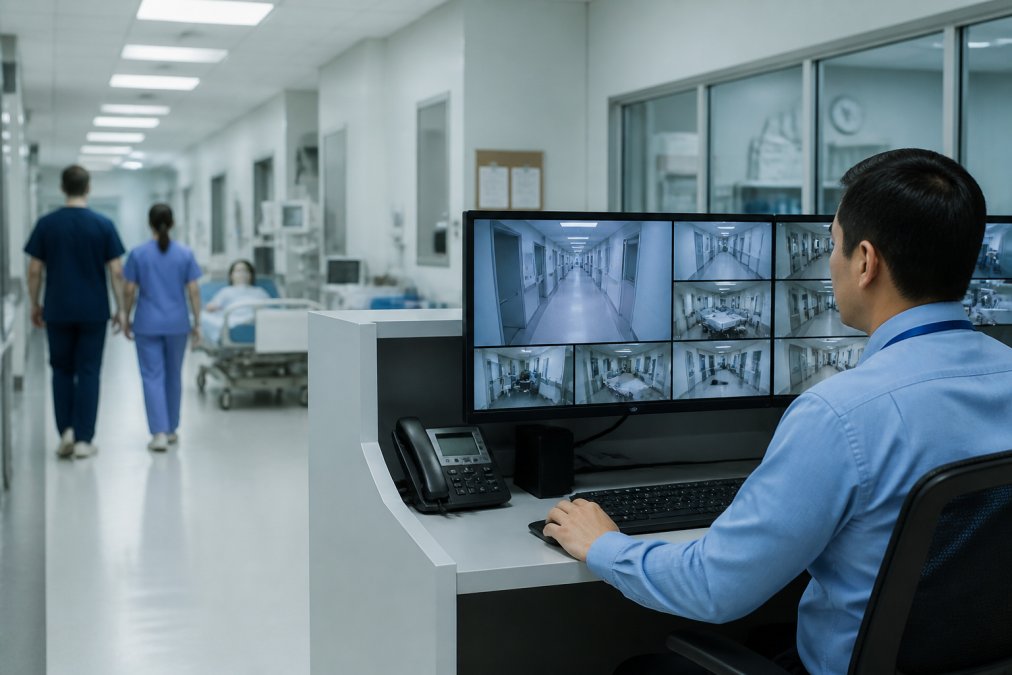
Here is where healthcare infrastructure security diverges from generic enterprise cybersecurity: your physical security systems now share a network with your clinical systems. IP cameras, badge readers, door controllers, and environmental sensors all run on the same infrastructure that carries patient data. A compromised camera is a foothold inside the building.
AI automation is starting to bridge that gap. Video analytics can detect tailgating at a locked medication room door and correlate it with a badge access log and an EHR access event in the same minute. If a badge opens a pharmacy door at 2:00 a.m. and a controlled-substance EHR record is accessed from that room 90 seconds later, that is a signal no single system would catch alone.
For healthcare providers in Los Angeles and across California, this convergence also has a compliance dimension. Physical safeguards under the HIPAA Security Rule and the access control requirements enforced by the California Privacy Protection Agency touch the same systems. Treating them as one security program is the only way to keep the audit trail coherent.
A Practical Device Security Checklist
- Maintain a live inventory of every connected device, including model, OS version, firmware, and network location
- Require an SBOM and a coordinated vulnerability disclosure policy from every new medical device vendor
- Segment clinical devices from enterprise IT and from each other where clinically feasible
- Monitor east-west traffic between zones with AI-based anomaly detection
- Enforce device identity wherever the device supports it, and use NAC profiling where it does not
- Correlate physical access events with digital access events for high-value areas like pharmacies and server rooms
- Test your device isolation playbook at least twice a year, because the first time you trigger it should not be during a live incident
Implementation Roadmap for SMBs and Mid-Sized Healthcare Providers
Smaller healthcare providers face the same threats as large hospital systems but with fewer resources, smaller IT teams, and no dedicated security operations center. A phased roadmap makes AI automation for healthcare infrastructure security achievable without a massive upfront investment, targeting a clinic, specialty practice, or rural hospital with one to three IT staff.
Phase 1: Assessment (Weeks 1-2)
Before buying anything, know what you have.
- Inventory all connected devices and network segments, including the ones nobody remembers installing
- Identify compliance gaps against HIPAA and California privacy requirements
- Document existing security tools and their coverage limitations
- Rank your systems by clinical criticality, not by how new they are
A common pattern: the highest-risk asset is not the newest one, but the legacy imaging workstation running an unsupported OS.
Phase 2: Quick Wins (Weeks 3-6)
- Deploy automated monitoring on your highest-risk network segments first
- Enable automated quarantine for known threat signatures
- Configure access control policies for your most sensitive data stores
- Turn on multi-factor authentication for every remote and administrative account
Multi-factor authentication blocks a large share of credential-based attacks on small providers. If you do one thing in this phase, do that.
Phase 3: Integration (Weeks 7-12)
- Connect legacy systems to the automated monitoring platform
- Implement network segmentation for IoT and medical devices
- Establish automated compliance reporting workflows
- Document your incident response playbook in plain language your staff can follow at 2 a.m.
Phase 4: Optimization (Ongoing)
- Tune machine learning models to reduce false positives
- Expand automated response playbooks based on incident data
- Conduct quarterly vulnerability assessments and tabletop exercises
- Review vendor contracts annually against current threat and regulatory conditions
Vendor-Neutral Evaluation: How to Choose an AI Security Platform Without Getting Sold
Most SMB healthcare providers end up evaluating managed security services rather than building an in-house SOC. That is the right call, but the evaluation process is where providers get burned. Here is a vendor-neutral framework for any platform.
1. Ask what the AI actually does. Some vendors use "AI" to mean a rules engine with a marketing budget. Ask for a live demonstration of anomaly detection on your own network traffic. If they cannot show a real detection on real data, the AI claim is decoration.
2. Ask about false positive rates and analyst escalation. A platform generating 500 alerts a day is worse than useless for a two-person IT team. Ask how many alerts reach a human analyst daily, and what the escalation path looks like.
3. Ask about HIPAA and CCPA/CPRA alignment specifically. A general-purpose MSSP may not know the difference between a HIPAA business associate agreement and a CCPA service provider contract. You need both. Ask to see a sample BAA and confirm the vendor will sign one.
4. Ask about healthcare-specific experience. Clinical environments have constraints general IT does not: uptime requirements, clinical workflow dependencies, and medical device protocols. Ask for references from providers of similar size.
5. Ask about exit and data portability. If you leave, what happens to your logs, configurations, and detection rules? A vendor that cannot answer clearly plans to keep you.
6. Ask about total cost over three years. Implementation fees, per-endpoint pricing, compliance reporting add-ons, and incident response retainers add up. Get the three-year number in writing before you sign.
Budget and Staffing Realities for SMBs
Most small and mid-sized healthcare providers cannot justify a full-time security analyst, and they should not try. The realistic model is a lean internal owner, usually the IT director or practice manager, paired with an external managed security provider. The internal owner handles policy, vendor relationships, and clinical coordination. The external provider handles 24/7 monitoring, threat hunting, and incident response.
For healthcare providers searching for managed security services near me in Los Angeles, the key is a partner who understands both the technology and California's regulatory environment. Ask how they handle CCPA and CPRA obligations alongside HIPAA, and request a sample compliance report.
Frequently Asked Questions
How does AI automation improve healthcare infrastructure security?
AI automation improves healthcare infrastructure security by continuously monitoring network traffic, user behavior, and device activity to detect threats in real time. Machine learning algorithms establish baselines for normal activity and flag anomalies that rule-based systems miss. When a threat is identified, automated quarantine can isolate affected systems before lateral movement occurs. This reduces the window between detection and containment from hours to seconds, which matters when ransomware can encrypt patient records in minutes.
What are the primary cybersecurity risks for healthcare organizations in Los Angeles?
Healthcare organizations in Los Angeles face risks including ransomware targeting patient data, unsecured IoT and connected medical devices, third-party supply chain vulnerabilities, and phishing attacks on clinical staff. The concentration of large hospital systems and research institutions in the region makes them high-value targets. California's CCPA and CPRA add data privacy obligations beyond HIPAA, and breach costs for healthcare remain among the highest of any industry.
How does AI-driven security help with HIPAA compliance?
AI-driven security supports HIPAA compliance by automating access control monitoring, generating audit trails, and enforcing data encryption policies across systems. HIPAA compliance automation tools can flag unauthorized access to protected health information in real time and produce compliance reports that would otherwise require manual review. This reduces the administrative burden on security teams while maintaining the documentation required for HIPAA audits and breach notifications.
Can AI automation detect healthcare data breaches in real-time?
AI automation can detect healthcare data breaches in real time by analyzing network traffic, login patterns, and data access behavior as they happen. Unlike periodic audits, real-time monitoring catches unauthorized access or exfiltration attempts within seconds. Automated incident response in healthcare then triggers containment actions such as session termination, credential revocation, or network segmentation. This speed is critical because the average healthcare breach takes months to identify without continuous monitoring.